

Partnership Models
Partnership Fit
Strategic Partnerships
Why AXANH
Discuss Your Needs





Strategic Partnerships
Strategic partnerships expand what AXANH can learn, build and contribute
AXANH develops selective relationships with universities, technology specialists, academic teams, established industry organizations and professional networks when complementary expertise can strengthen people, technical practice, strategic judgment or long-term organizational capability.
The purpose is not to build a large network for its own sake. It is to connect AXANH with expertise, perspective and opportunities that would be difficult—or slower—to develop in isolation.
A strong partnership ecosystem expands what AXANH can learn, build and contribute.
Why It Matters
Partnership value starts with a clear contribution
A recognizable name can create visibility. A useful relationship should do more. It should bring knowledge, perspective, access or a development pathway that changes what the organizations can do—not simply how they appear.
That is why AXANH treats strategic partnership as a working idea rather than a status label. The question is practical: what can become stronger because this relationship exists, and is there a credible way for both sides to contribute to that change?
The value of a partnership is easier to judge when its contribution can be named.
Partnership Ecosystem
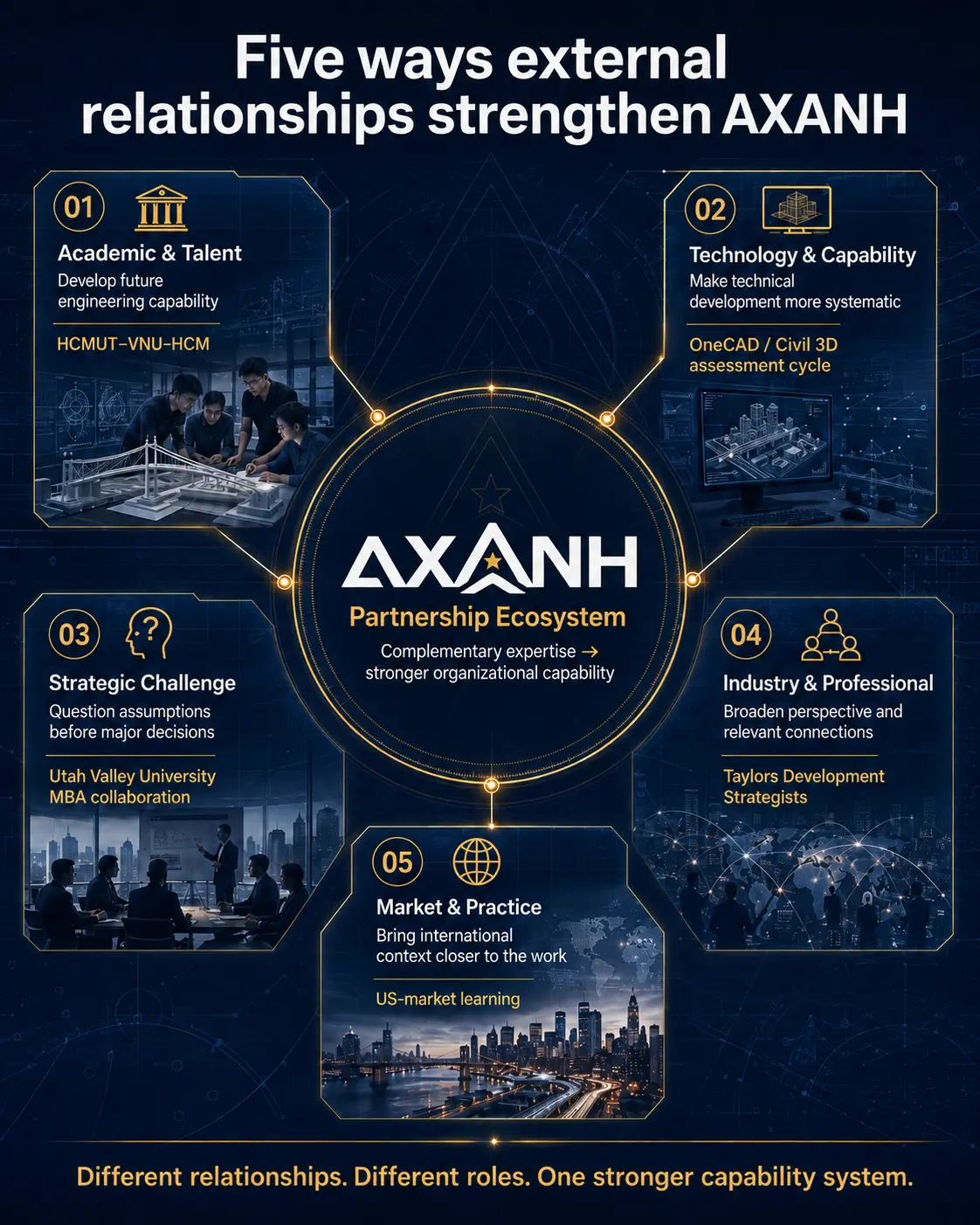
Different relationships strengthen different parts of AXANH
AXANH does not expect one type of relationship to solve every problem. Academic collaboration, technology relationships, external strategic challenge and industry connection each serve a different purpose. Market learning then helps translate some of those external perspectives into day-to-day professional judgment.
| Relationship role | What it strengthens | Evidence or example |
|---|---|---|
| Academic & Talent | Future engineering capability and earlier exposure to professional practice | HCMUT–VNU-HCM collaboration |
| Technology & Capability | Structured technical development and recurring assessment | Autodesk, OneCAD, Bentley, 12D |
| Strategic Challenge | External perspective on important growth and organizational questions | Utah Valley University MBA engagement |
| Industry & Professional | Industry perspective, relevant connection and professional network development | Taylors Development Strategists |
| Market & Practice Learning | Context behind international engineering work and client expectations | Documented US-market learning |
Academic & Talent
Future capability starts long before a vacancy appears
When talent development begins only after a role becomes urgent, there is little time to build professional context. Academic collaboration creates an earlier bridge between education, applied learning and the expectations engineers will eventually meet in practice.
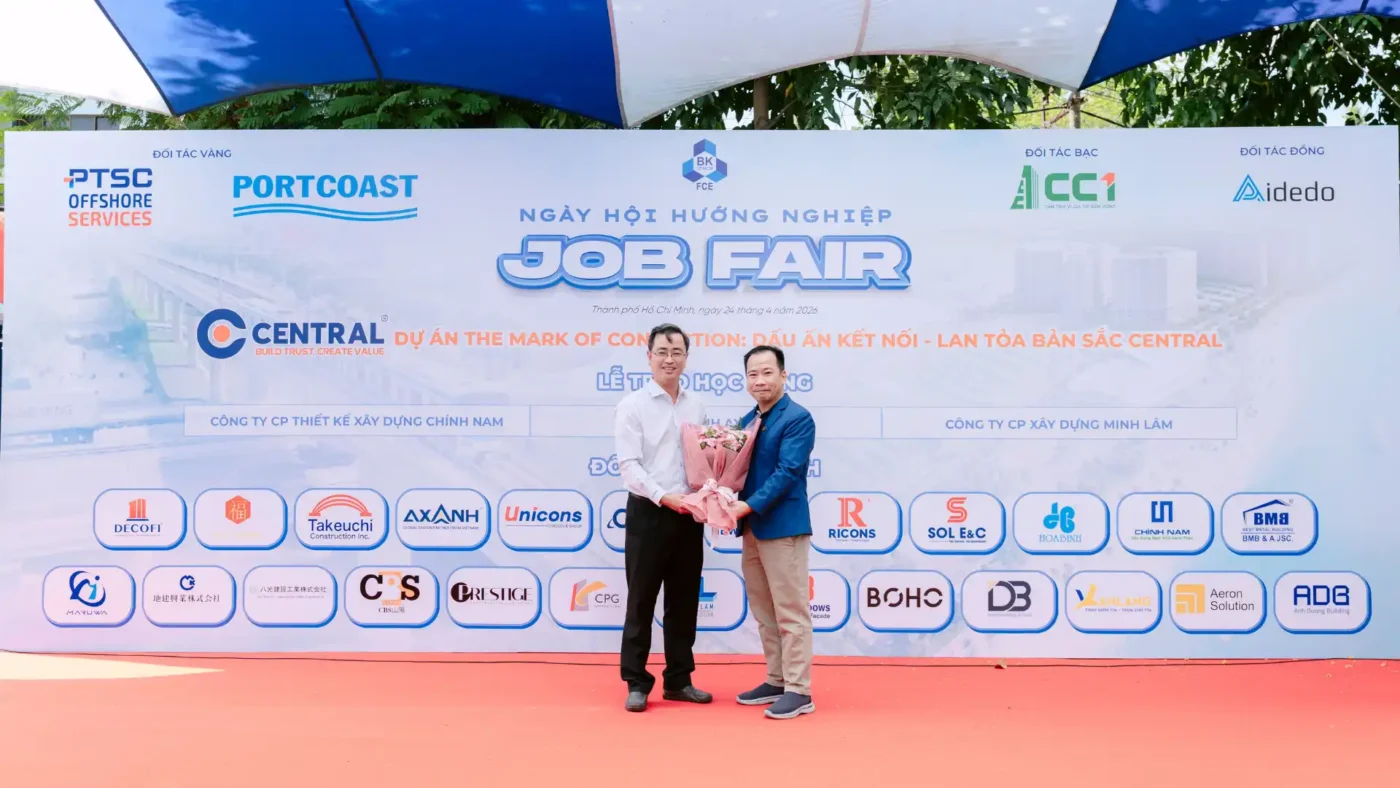
AXANH and Ho Chi Minh City University of Technology – VNU-HCM have established a three-year collaboration framework covering scholarships, practical learning, internships, graduation projects, career orientation, technical exchange and talent development.
Connect with practice
Internships and graduation projects give students defined settings to apply academic foundations in a professional context.
Exchange technical context
Technical exchange helps connect classroom knowledge with tools, workflows and questions that appear in professional practice.
Make careers more visible
Career orientation helps emerging engineers understand the standards, habits and responsibilities expected in international project environments.
2026 Implementation
VND 50 million in scholarship sponsorship
In 2026, AXANH completed VND 50 million in scholarship sponsorship within the documented collaboration framework. The milestone matters because it moves one part of the agreement from intention into implementation.
An academic framework becomes more meaningful as its pathways move from document to practice.
Strategic Challenge
Good strategy should be challenged before it becomes a commitment
From January to May 2026, AXANH worked with a Utah Valley University MBA strategic consulting team, with academic guidance from Professor Don Capener, Ph.D., Dean of Continuing Education at Utah Valley University, to examine AXANH’s three-to-five-year growth direction.
The engagement explored premium-partner positioning, structured partnerships, phased international growth, organizational readiness and how to preserve the people-first culture behind delivery quality.
The objective was not external approval. It was external challenge.
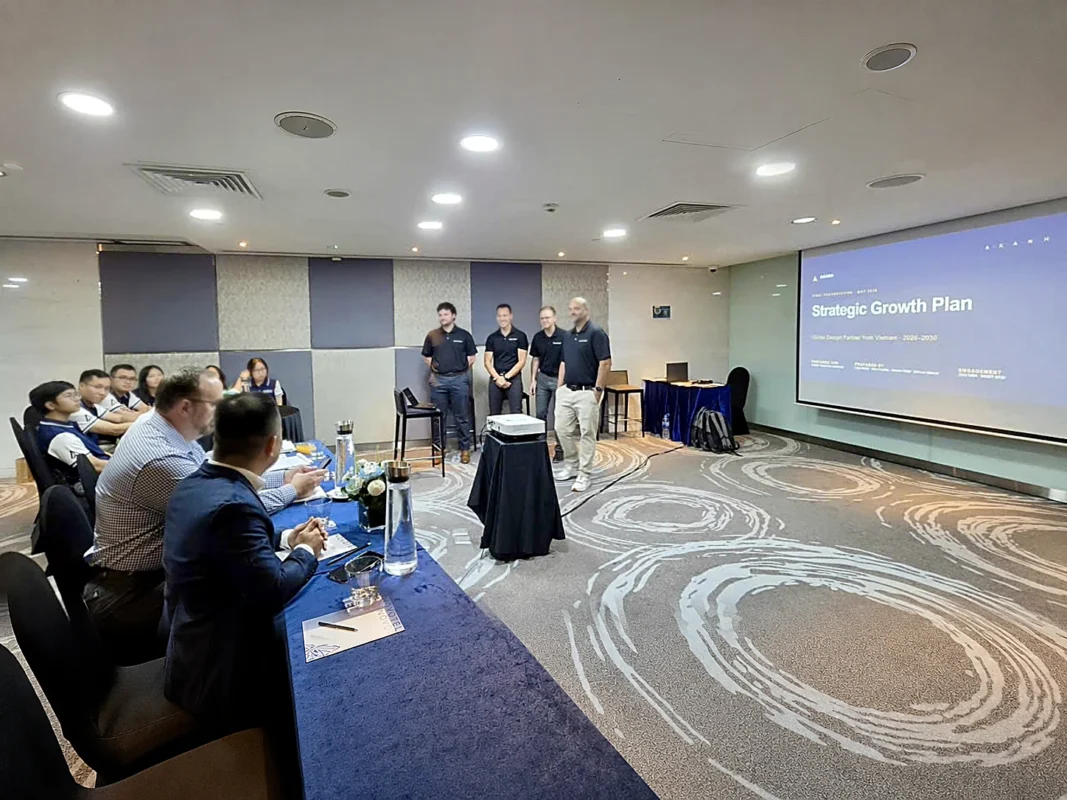
Public communication covers the verified collaboration and approved high-level themes. The final report and confidential strategic, financial and operational material remain controlled.
Industry & Practice
Industry relationships widen the perspective around delivery
Engineering capability does not develop only through internal learning or academic connection. Established industry relationships can add a different kind of value: practical perspective, relevant professional connection and challenge from organizations that have worked through different cycles of the profession.
AXANH develops these relationships selectively. Their value depends on the role they actually play—whether that is connecting complementary expertise, opening relevant professional relationships, contributing strategic perspective or helping the organizations recognize where working together could create stronger value.
Industry relationships matter when they create useful access to perspective, capability or opportunity.
Strategic Referral Partnership
Taylors Development Strategists
Taylors Development Strategists, an organization with more than 65 years of experience, is a Strategic Referral Partner of AXANH. The relationship gives AXANH a valuable channel for industry reference, strategic perspective and international connection as AXANH continues to develop its capability and professional network.
Technology & Capability
Technology relationships should build repeatable capability
Technology access matters, but it is not the same as organizational capability. A stronger relationship connects learning with a recurring checkpoint so development can be revisited as the team changes and engineers gain experience.
Each year, every eligible AXANH engineer with at least 12 months of tenure enters the Civil 3D Completion assessment cycle organized on-site by OneCAD. AXANH’s standard is 100% completion by the annual eligible cohort, with additional preparation and reassessment where needed.
The value is a recurring team-level development checkpoint, not simply another training event.
Prepare
Engineers focus development on the knowledge and workflow areas relevant to the assessment.
Assess
The annual cycle provides a common checkpoint for the eligible engineering cohort.
Develop
Where more preparation is needed, learning can be directed toward the gaps identified.
Reassess
Engineers who need additional development return to the assessment rather than ending the process at the first result.
Market & Practice
International context strengthens professional judgment
Cross-border engineering involves more than producing drawings or models. Teams also need context around how information is organized, how reviews are handled, how expectations are communicated and how decisions move through the wider project process.
AXANH has invested in direct US-market learning, including a documented on-site business and civil-design program in Napa, California, in 2018, followed by further US exposure in 2023.
Market learning is valuable when external context finds its way back into everyday professional practice.
Documented Market Learning
Napa 2018 · US exposure 2023
The 2018 program covered project process, key sheets, parking, subdivision, drainage, quantity takeoff, templates, drafting techniques and teamwork. Further US exposure in 2023 continued that direct-learning thread.
Choosing Relationships
We choose relationships for contribution, not visibility
A useful relationship does not need to satisfy every criterion below, but its purpose should be clear enough to explain why both organizations are investing time, expertise or access. The stronger the public label, the stronger the evidence and scope discipline should be.
01
Clear purpose
There should be a defined capability, knowledge need, opportunity or problem that the relationship is meant to address.
02
Complementary contribution
Each side should bring something useful that would be slower, harder or less effective to build in isolation.
03
Evidence of activity
The relationship should be described according to what has actually been agreed, implemented or verified—not the label alone.
04
Mutual value
A durable relationship needs a credible reason for both organizations to contribute attention, knowledge or access over time.
05
Sustainable scope
The relationship should remain understandable and governable as activities, people or public communication evolve.
Different relationships do different jobs
AXANH uses relationship language according to the documented role and scope rather than applying one label to every external connection.
| Relationship term | Use when | What the term communicates |
|---|---|---|
| Formal institutional collaboration | A signed agreement, MOU or partner-confirmed institution-level program exists | A defined collaborative scope between organizations |
| Program collaboration | A documented project, research, MBA/eMBA, faculty-led or other defined program exists | Collaboration within that specific program or project |
| Strategic referral partnership | A documented relationship is centered on relevant professional connection and strategic opportunity | A referral and strategic-connection role within the verified scope |
| Technology & capability relationship | The relationship supports technology access, learning, assessment or capability development | A capability role without automatically implying broader strategic-partner status |
| Professional connection | A useful industry relationship exists without evidence for a broader formal partnership label | A professional relationship described within its actual scope |
Collaboration Governance
Clear boundaries make collaboration easier to trust
A strategic collaboration becomes more useful when its purpose, scope and communication boundaries remain clear. Different relationships may involve research, learning, referrals, technology, professional exchange or shared programs; each requires governance appropriate to what the organizations are actually doing together.
Scope
Define the work
Clarify the objective, activities, participants and review point so implementation remains aligned with what both sides actually agreed.
Confidentiality & IP
Protect what should stay controlled
Identify which reports, methods, research, operating information or intellectual property may be shared, retained or kept within a controlled environment.
Public Communication
Use names and images carefully
Institutional names, logos, event photographs and third-party marks should be used within the permission applicable to the specific relationship and communication use case.
Review
Keep the description current
Revisit public wording when the scope, participants, program status or permissions change so the website reflects the relationship as it exists now.
Frequently Asked Questions
Questions that keep partnership language precise
Different external relationships carry different levels of formality, purpose and evidence. These distinctions help readers understand what AXANH means when it describes a collaboration, connection or strategic partnership.
What makes a relationship strategic at AXANH?
AXANH uses the term when a documented relationship has a clear purpose and a credible path to strengthen capability, talent development, strategic judgment, professional connection or long-term shared value. The label follows the contribution and verified scope; it is not assigned simply because two organizations know or work with one another.
Does every academic connection count as a partnership?
No. AXANH distinguishes formal institutional collaboration, program collaboration, academic connection and student affiliation. A signed or partner-confirmed institution-level program can support formal collaboration language, while internships, faculty contact, research visits or student affiliation are described according to their narrower documented scope.
What does Strategic Referral Partner mean on this page?
On this page, Strategic Referral Partner refers to the documented role held by Taylors Development Strategists in relation to AXANH. The public description is limited to the supported scope: industry reference, strategic perspective and professional or international connection. It does not add unverified referral volumes, commercial terms or outcomes.
How does AXANH describe industry and technology relationships?
AXANH describes each relationship according to the role that can be verified. A technology relationship may support access, learning, assessment or capability development; an industry relationship may provide professional connection, perspective or strategic opportunity. Neither category is automatically upgraded to a broader strategic-partner claim without supporting scope and evidence.
How is this different from the AXANH Partnership Model?
Strategic Partnerships describes the external ecosystem around AXANH—universities, technology specialists, academic teams, industry relationships and professional connections. The AXANH Partnership Model addresses a different question: how a client may work directly with AXANH through an engagement structure matched to its delivery needs and readiness.
Client Engagement
Looking for a client engagement model?
If you are evaluating how your organization could work directly with AXANH, the Partnership Model is the relevant path. A fit discussion can help clarify the appropriate starting point.
Build With Purpose
Bring the capability you want to strengthen together
AXANH welcomes focused conversations with universities, technology organizations, research and academic teams, established industry organizations and professional networks when complementary expertise can create meaningful value for both sides.
A Useful Starting Point
What could become stronger?
Begin with the capability, knowledge, talent pathway, market connection or professional opportunity the relationship could strengthen. Purpose should come before the partnership label.