

Partnership Models
Partnership Fit
Strategic Partnerships
Why AXANH
Discuss Your Needs



Partnership Design
Built to support the way your business grows
AXANH designs partnership structures carefully around each client’s operating needs, continuity requirements and long-term direction. The goal is not to fit clients into a fixed model, but to support growth in the most suitable and sustainable way.
Relationship Architecture
The important question is what the client needs AXANH to take responsibility for
Similar team sizes can operate under very different relationship models. In one situation, a client may need AXANH to complete a clearly defined scope. In another, the client may want familiar engineers who retain project context over time. Another relationship may require AXANH to manage a delivery unit or take broader responsibility across part of the design operation.
The partnership architecture makes those differences visible. It separates headcount from the more important questions of continuity, day-to-day management, delivery responsibility, operating integration and long-term ownership intent.
The useful question is not, “Which model is highest?” It is, “What responsibility do you need AXANH to carry?”
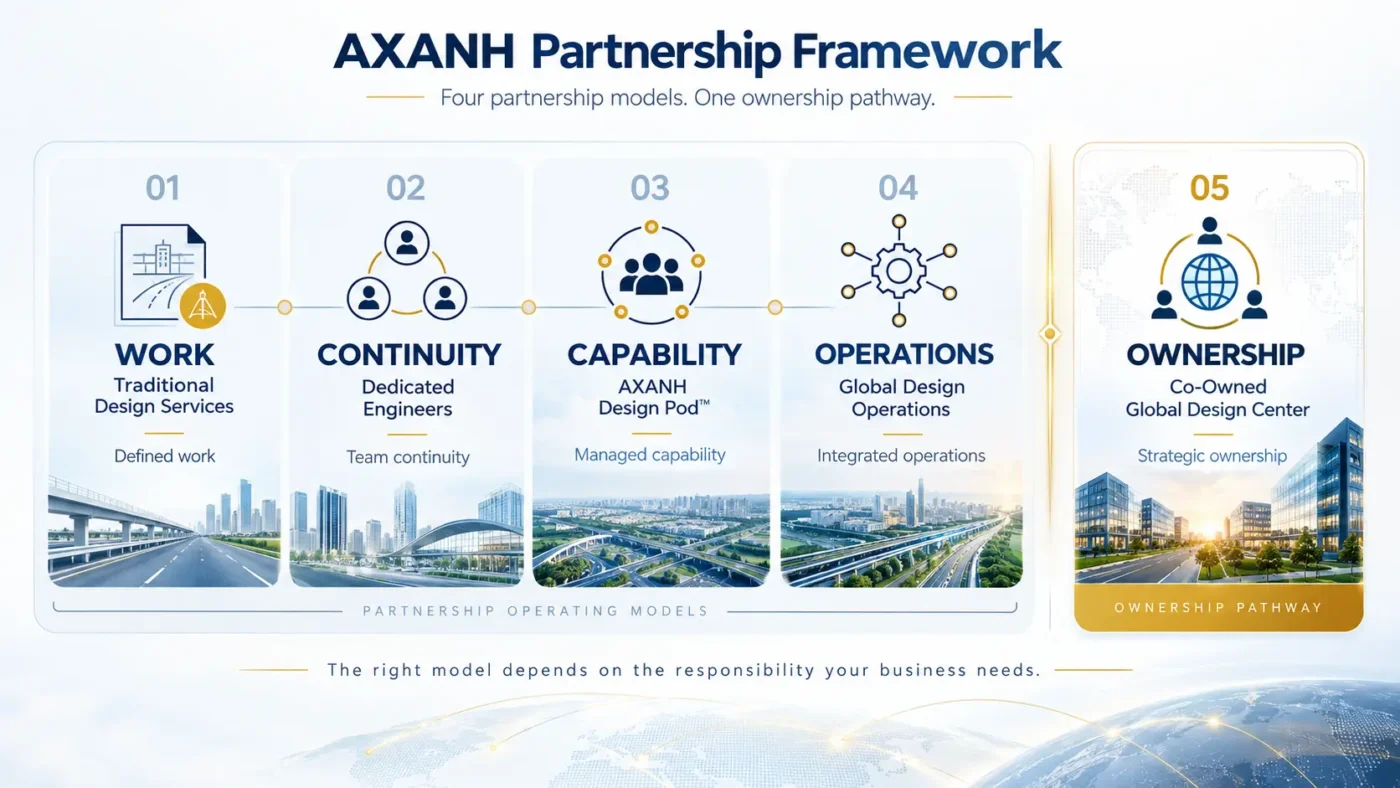
AXANH Partnership Framework
Four ways to work together — and one strategic ownership pathway
The public framework focuses on the client decision: what you need, how the relationship is managed and what AXANH is expected to take responsibility for. The detailed operating architecture behind each model remains deliberately controlled.
01
WORK
Traditional Design Services
For defined projects, scopes or deliverables where the required work and responsibilities can be established clearly.
Client need: Flexible access to design capability for clearly defined work.
02
CONTINUITY
Dedicated Engineers
For recurring work where familiar engineers and retained client context are valuable, while the client continues to direct much of the day-to-day work.
Client need: Greater continuity without building a separately managed delivery unit.
03
CAPABILITY
AXANH Design Pod™
For clients who want a structured delivery unit rather than managing individual engineers, with AXANH taking greater responsibility for coordination and delivery discipline.
Client need: Managed capability, not simply additional individual resources.
04
OPERATIONS
Global Design Operations
For more integrated relationships where AXANH may take broader responsibility across selected design workflows, capacity, quality, knowledge and continuous improvement.
Client need: A more integrated operating capability rather than a headcount-based relationship.
05 · ENTERPRISE OWNERSHIP MODEL
Co-Owned Global Design Center — Ownership
This is structurally different from the four partnership models above. It is a long-term strategic pathway for organizations considering the development of a design capability in Vietnam with a genuine ownership objective.
It is not a standard service package and is not presented as the automatic next step after Global Design Operations. Any such direction requires a separate business, operating, governance and legal evaluation before a specific structure can be discussed.
Interested in this direction? AXANH can explore the concept at a high level during an initial strategic conversation. Detailed ownership and operating structures are shared only when the opportunity is sufficiently qualified.
Selective disclosure by design. This page explains the relationship choices and client value. Detailed commercial mechanics, operating thresholds, internal capability criteria, proprietary workflows, security architecture and ownership mechanics are not published publicly. Relevant detail can be discussed progressively through discovery, proposal development or controlled due diligence.
What Determines Fit
Headcount does not determine the partnership model
A large team is not automatically a deeper partnership, and a smaller relationship can still involve substantial operating responsibility. Model fit depends on what the client actually needs the relationship to do.
Work Pattern
What kind of demand are you managing?
Defined packages, recurring workflows and longer-term operating demand create different requirements for continuity and planning.
Management Model
Who should manage the day-to-day work?
Some clients want to direct familiar engineers themselves. Others want AXANH to manage a defined delivery unit or broader operating responsibility.
Responsibility
What do you want AXANH to own?
The relationship can range from responsibility for defined deliverables to greater responsibility across coordination, workflow, quality, knowledge and improvement.
Long-Term Objective
Is the objective service capacity or ownership?
Most relationships remain service partnerships. An ownership objective changes the nature of the discussion and requires a separate strategic and enterprise evaluation.
FIT BEFORE SCALE
The right partnership is the one that fits the business
A partnership should be shaped around the work that needs to be done, the continuity that creates value and the responsibilities each organization is ready to carry.
Greater integration is not automatically better. In some situations, flexibility matters most. In others, continuity, stronger coordination or broader operating support may become more valuable.
The right structure is therefore determined by business need and operating readiness — not by a predetermined path or level of complexity.
Partnership Fit
Start with the operating need
Partnership Fit considers workload patterns, continuity needs, management preferences, responsibility boundaries and long-term direction before a relationship is configured.
Relationship Evolution
The model changes only when the underlying relationship changes
A project relationship may become recurring. A recurring relationship may benefit from greater continuity. A client that no longer wants to manage individual resources may prefer a managed delivery unit. In some mature situations, the client may want AXANH to take broader responsibility across part of the design operation.
None of those changes should happen simply because time has passed or the team has grown. The model changes when the business need, responsibility boundary and operating environment justify a different structure.
An ownership discussion is different again. It should begin because ownership itself is a strategic objective — not because a service relationship has reached an arbitrary level of maturity.
What We Share Publicly
The decision logic is visible. The operating system is not.
Clients should be able to understand the available directions before speaking with AXANH. The detailed configuration behind those directions — including proprietary operating methods, commercial thresholds and deeper governance mechanics — is discussed only when it becomes relevant to a real engagement.
Continue the Evaluation
Understand the structure first. Configure the relationship second.
Architecture, suitability, operating mechanics and quality controls answer different questions. Keeping them separate makes the partnership easier to evaluate.
01 · Structure
Compare Partnership Models
Understand the difference between work, continuity, managed capability, integrated operations and a separate ownership objective.
02 · Suitability
Check Partnership Fit
Evaluate the workload, management model, responsibility boundary and long-term objective before choosing a starting direction.
03 · Operation
See How We Work
Understand how onboarding, standards alignment, communication, coordination and review support the relationship in practice.
04 · Quality
Explore Quality & Review
See how Self-Check, Peer Review and Manager Review contribute to AXANH’s quality approach without assuming that one review model replaces project-specific professional judgment.
Frequently Asked
Questions about the AXANH partnership framework
The public framework explains the relationship choices. Detailed configuration becomes more specific only when the client context is sufficiently clear.
Are these fixed commercial packages?
No. The models describe materially different relationship structures and responsibility boundaries. Scope, governance and commercial configuration are developed around the actual engagement rather than assumed from the model name alone.
What is the difference between Dedicated Engineers and an AXANH Design Pod?
Dedicated Engineers are suited to clients who value familiar, continuing resources and want to retain significant day-to-day direction. An AXANH Design Pod™ is a managed delivery unit in which AXANH takes greater responsibility for coordinating the team and delivery discipline. The distinction is management responsibility, not simply team size.
Is Global Design Operations simply a larger Design Pod?
No. Team size does not define the model. Global Design Operations becomes relevant when the client needs AXANH to take broader responsibility across selected operating areas such as workflow, capacity, quality, knowledge and improvement. The exact operating boundary is defined during a deeper engagement discussion.
Why is the Co-Owned Global Design Center shown separately?
Because it introduces an ownership objective rather than simply a deeper service relationship. It is an enterprise pathway for qualified strategic situations and requires separate business, governance and legal evaluation. Public information intentionally remains conceptual until there is a serious reason to explore the structure further.
Is a higher-numbered model always better?
No. A model is useful only when it fits the client’s actual need and both organizations can support the responsibilities involved. A defined project model may remain the right answer for many relationships, while another client may have a valid reason to begin with dedicated resources or managed capability.
Do clients need to move through the models in sequence?
No. Clients can begin with the structure that fits their current operating environment. A relationship may also remain in the same model for the long term. Movement occurs only when the underlying need and responsibility boundary change.
Why does AXANH not publish the full operating model?
The website is intended to help clients understand the available directions, not expose the proprietary mechanisms behind them. Detailed workflows, capability criteria, commercial logic, governance configuration and ownership mechanics are discussed selectively through discovery, proposal development or due diligence where appropriate.
How are Partnership Models different from How We Work?
Partnership Models defines the relationship architecture. How We Work explains how collaboration operates through onboarding, standards alignment, communication, coordination and review.
The Next Conversation
Start with the responsibility you need — not a predetermined package
Tell us how your workload operates today, where continuity or management burden is becoming difficult, and what you want a long-term design partner to take responsibility for. We can then explore the most appropriate starting structure and, where relevant, discuss the next level of detail privately.