

Partnership Models
Partnership Fit
Strategic Partnerships
Why AXANH
Discuss Your Needs



Engineering capability
How AXANH Builds Engineering Capability
When an AEC firm evaluates a distributed engineering team, software proficiency and project experience matter. The deeper test is whether the team can understand the context behind the work, carry useful learning beyond one individual, and recognize what must remain specific to a client, project, or jurisdiction.
Part of AXANH’s engineering capability has been shaped over time through direct exposure to client environments, project sites, and experienced engineers – then by bringing useful learning back into the wider team through documentation, knowledge sharing, application, and review.
The question is not only who had the learning experience. It is whether the right knowledge can continue creating value after that experience ends.
The central idea
Learning is only the beginning
Direct experience can add context. Organizational capability begins when useful knowledge reaches the right people and is reused within the right boundaries.
Some lessons can strengthen general practice. Others must remain specific to the client, project, or jurisdiction where they belong.
From learning to capability
What turns learning into organizational capability?
An experience does not become capability simply because it happened. Its value grows when an organization understands what was learned, decides what is safe and useful to retain, and makes that knowledge available to the people who need it.
01
Context has to be understood
Knowing what to do is not the same as understanding why it matters. Engineers need enough context to recognize the purpose behind a requirement and to see when an assumption, input, or decision is still unclear.
Context supports judgment. It does not replace standards, review, or professional responsibility.
02
Knowledge has to travel
If a useful lesson exists only in the memory of the person who experienced it, the organization still depends on that individual. Capturing and sharing the lesson gives the right people a stronger starting point.
Shared capability grows when knowledge can move without losing its source, scope, or meaning.
03
Reuse needs boundaries
One lesson may become useful practice across many assignments. A client standard, template, jurisdictional requirement, or project decision may belong only within a defined context.
Mature QA/QC includes knowing what should not be generalized.
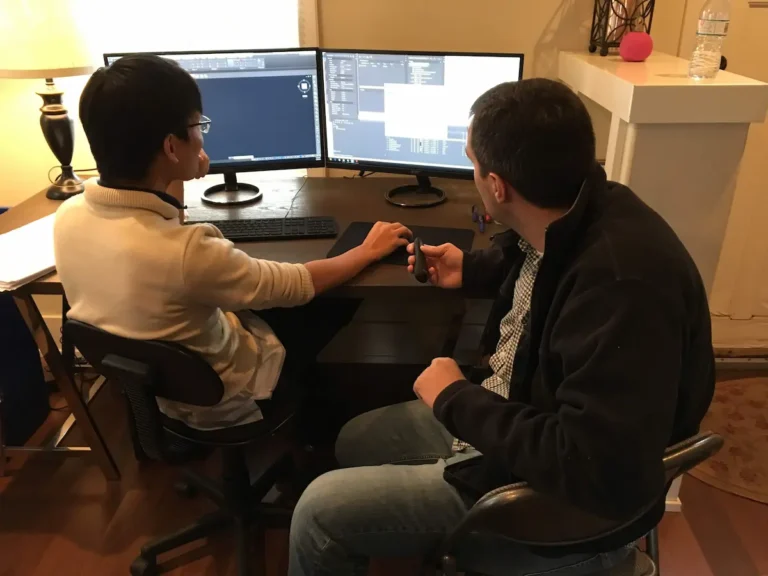
Napa, California – 2018. Two engineers from the AXA Engineers chapter spent approximately two months learning inside a client’s working environment.
2018 – Napa, California
Learning the process behind the drawing
In 2018, when the company was operating as AXA Engineers – the engineering heritage behind AXANH – two engineers spent approximately two months learning inside a client’s working environment in Napa, California.
The objective was broader than software proficiency. The program covered project process, plan production, drainage, subdivision work, quantity takeoff, templates, drafting practices, and teamwork – the surrounding context that helps an engineer understand how a drawing fits into a broader civil engineering workflow.
The learning continued after the engineers returned to Vietnam. Their experience was documented in reports and shared through internal training, giving a wider team access to lessons that otherwise could have remained with two individuals.
Two engineers experienced the program directly. A much larger team had an opportunity to learn from what they brought back.
2023 – North Carolina
When the drawing meets the jobsite
In 2023, Anthony Nguyen and a manager from AXA Engineers traveled to North Carolina for an intensive business and engineering learning program with a U.S. partner.
This time, several environments that engineers often experience separately came together: the design office, project meetings, engineering decisions, the client organization, and the actual construction site.
Seeing the work in physical space
The team visited projects in North Carolina that engineers in Vietnam had helped support. Contours, profiles, road grades, drainage systems, ponds, and details that had existed on screen could now be understood against real topography, space, and construction conditions.
A retaining wall, for example, was no longer simply a detail to place correctly on a plan. Seeing one in context added another way to think about the relationship between grading, usable space, pond geometry, drainage, and physical constraints.
Understanding the client’s working environment
Time in the client office also exposed the management team to communication practices, project coordination, meetings, working tools, and everyday expectations inside a U.S. engineering firm. The purpose was not to copy another company’s culture. It was to understand the client’s environment well enough to work within it more naturally.
When engineers can better imagine how a design will exist in the real world, they have more context for asking useful questions while the work is still being designed.
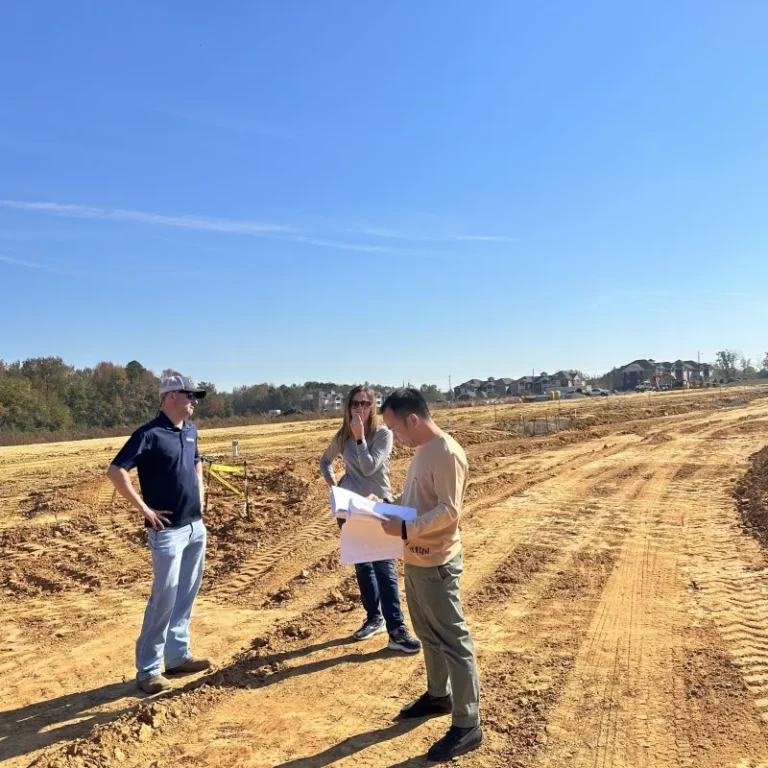
North Carolina – 2023. Direct market learning connected design work with the client environment and real project sites.
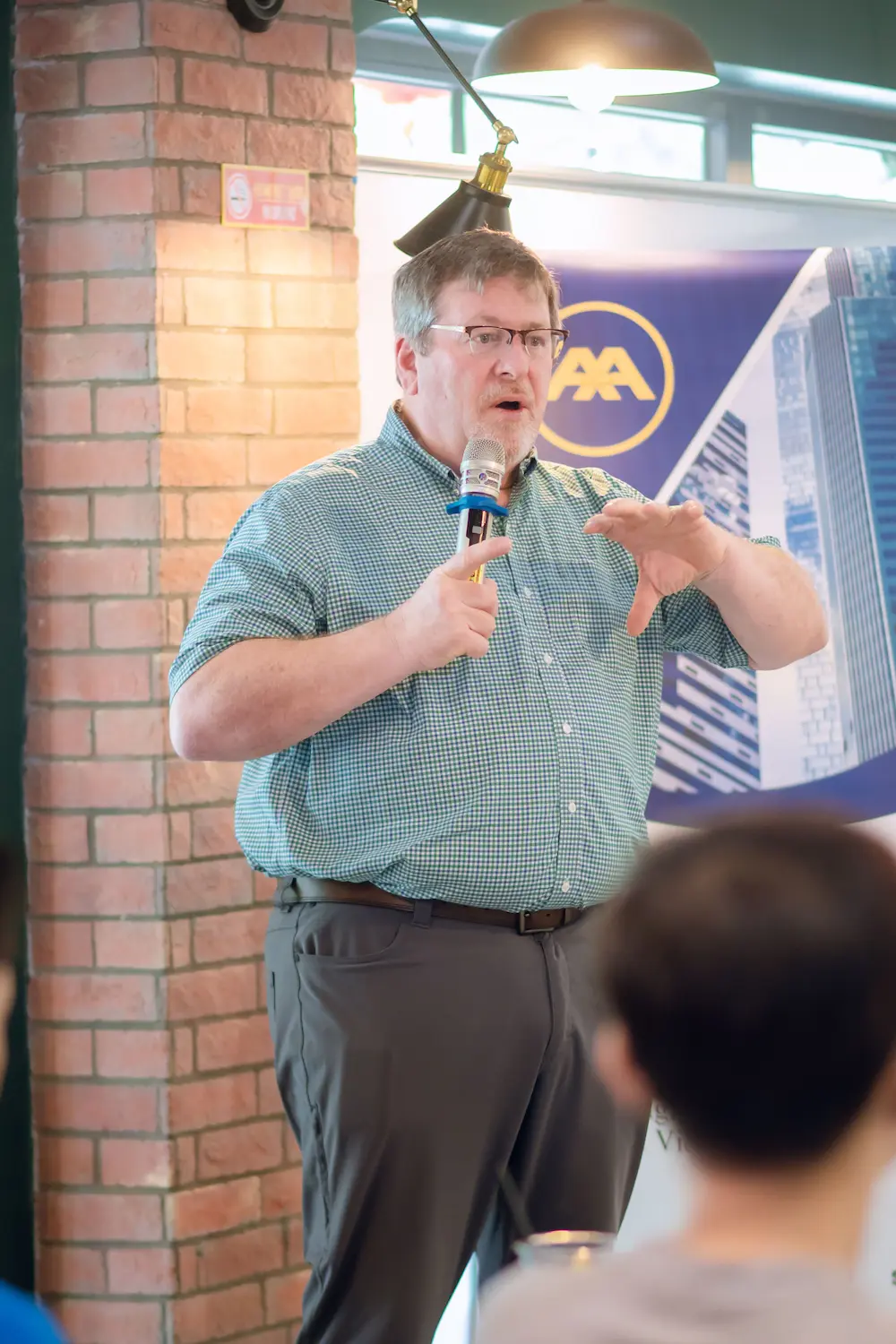
Vietnam – 2025. A technical knowledge-sharing session with Eric Hasenoehrl, PE, of Keltic Engineering.
2025 – U.S. PE training in Vietnam
Bringing professional engineering context closer to the team
Learning does not always require sending engineers to the United States. In 2025, while the company was still operating as AXA Engineers, Eric Hasenoehrl, PE, of Keltic Engineering traveled to Vietnam and worked directly with the engineering team.
The program covered practical civil engineering topics including site and roadway grading, retaining-wall-related grading, storm drainage, erosion control, water and sewer design, and related methods and documentation. Discussions included TR-55 analysis, the Rational Method, Erosion Control Plans, and SWPPP documentation.
The value of this format was the chance to ask questions while the reasoning was still part of the conversation – to hear not only a proposed approach, but why it may make sense under one set of conditions and need to be reconsidered under another.
Direct professional learning adds context. It does not replace client standards, project review, jurisdiction-specific requirements, or the responsibilities defined for the engagement.
The system today
Where does useful knowledge go today?
These historical learning experiences are not meant to stand alone as three training stories. Today, AXANH connects people development, review, practice knowledge, and standards work through a broader capability system that gives appropriate lessons somewhere to go.
Not every lesson goes to the same place. Some can become reusable guidance or practice knowledge. Other information must remain controlled as client-specific context, confidential material, project requirements, or jurisdiction-specific direction.
An important boundary
Not every lesson becomes a shared standard
Reusable practice can be organized and shared when appropriate. Client standards, jurisdictional requirements, controlled templates, confidential information, and project decisions remain within the scope and access boundaries that apply to them.
Knowledge continuity is useful only when source, scope, review, and access remain clear.
01
AXANH Academy
Develop people
Onboarding, mentoring, capability pathways, and recurring assessment create places for learning to re-enter an engineer’s development instead of ending with a single training event.
02
Engineering Intelligence
Develop practice knowledge
Recurring technical questions, review points, and appropriate lessons from delivery can be selected, reviewed, and developed within Practice Knowledge, Applied AI, or Research & Standards.
03
Quality & Review
Return feedback to the work
Self-Check, Peer Review, and Manager Review keep review close to production. Recurring findings can also become inputs for checklists, guidance, training, or future review points when appropriate.
What it can mean for clients
Accumulated context can make a relationship more useful
The value of learning programs is not the number of trips or training sessions. The more useful question is what a team brings back into the work – and whether that helps both organizations coordinate with more shared context over time.
When engineers understand more of the reasoning behind a requirement, they have a better basis for recognizing what still needs clarification. When feedback is retained appropriately, decisions and working expectations that have already been clarified do not always need to be rebuilt from zero.
This is not a promise that every future assignment becomes easier. Team composition, scope, standards, jurisdiction, and project conditions can change. The value lies in having a disciplined way to retain what should carry forward and to revisit what no longer fits the context.
Two kinds of knowledge
Reusable practice and project-specific context
Reusable practice may include a self-check habit, review point, communication practice, or lesson that remains useful after appropriate review.
Project-specific context may include client standards, jurisdictional requirements, templates, decisions, confidential information, or assumptions that belong only within a defined scope.
A credible learning system needs both the ability to share and the discipline to preserve boundaries.
When evaluating an engineering partner
Do not stop at what the team has been taught. Ask how knowledge is used.
Training, assessment, and market exposure are inputs. For a buyer, the stronger test is how knowledge moves through the team, where it is allowed to apply, and how it is reviewed when the project context changes.
01
Does knowledge travel beyond the individual?
If only one person understands the client standards or project context, capability remains fragile. Look for a way to capture useful knowledge and move it to the people who actually need it.
Look for continuity without losing the source, scope, or ownership of the knowledge.
02
Does the team distinguish reusable practice from project requirements?
A lesson from one project may improve judgment without becoming a rule for the next. Client standards, jurisdiction, preferences, and professional responsibilities still need to be identified for each assignment.
Look for controlled reuse, not a single template applied to every context.
03
Can engineers recognize when context is missing?
A mature team does more than follow instructions correctly. Engineers need to recognize when an assumption, input, requirement, or decision path is not clear enough to continue responsibly.
Look for the ability to clarify and escalate while there is still time to act.
04
Does each project leave the next one better prepared?
When feedback and lessons are retained appropriately, a longer relationship can reduce the need to re-explain what both teams have already clarified and help them build a more useful working language.
Look for learning that returns to delivery instead of ending with the retrospective.
When the relationship allows it
Mutual learning can create a better next cycle
Some important steps in the engineering journey from AXA Engineers to AXANH happened when clients and experienced engineers shared more of the context behind the work – not only what needed to be done, but how problems were considered and decisions were made.
Not every client relationship needs or allows this depth of exchange. But when scope, confidentiality, access, and the working relationship support it, knowledge transfer can become part of how two teams improve the way they work together.
The client shares context
Standards, reasoning, review expectations, or operating context are made clear within the appropriate scope.
AXANH learns through the work
The team connects that context with the assignment, asks questions when needed, and builds a clearer understanding of how the client’s work moves.
Useful learning is retained appropriately
Reusable lessons may return as guidance, onboarding material, review points, or practice knowledge. Client-specific information remains within its proper boundary.
Delivery creates new feedback
Review comments, recurring issues, and new clarifications can inform the next learning cycle when the relationship continues.

Start with the right question
Expanding a team also means expanding context
When an AEC firm needs more engineering capacity, the question is not only, “How many people do we need?” An equally important question is, “What does the extended team need to understand to work effectively inside our system?”
Standards, review expectations, terminology, sources of truth, communication preferences, decision rights, and escalation paths all influence whether added capacity becomes genuinely useful.
If AXANH is one of the partners you are considering, the next conversation can stay practical: the work you need to support, the context that matters, what should be transferred, and what level of integration makes sense for both organizations.