








ISO 19650 information management addresses a challenge that becomes more important as BIM delivery scales: how project information is structured, exchanged, controlled, and understood across teams.
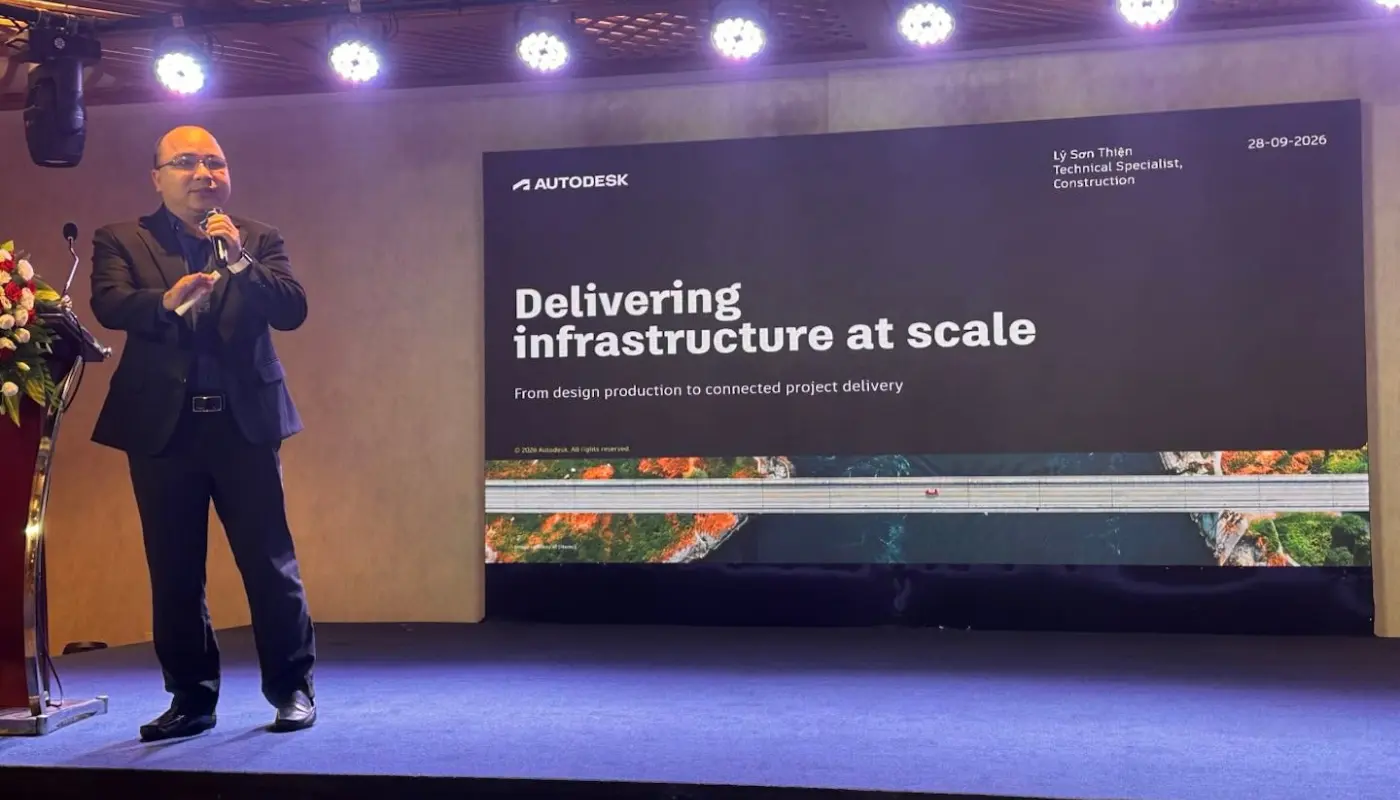
On September 28, 2026, AXANH participated in a training session on the application of ISO 19650 to BIM and information management with Thien Ly, an Autodesk expert in ISO 19650.
The session formed part of AXANH Growth & Technology Day 2026, which brought together internal capability development and technical learning with Autodesk and OneCAD.
For AXANH, the subject matters for a reason that extends beyond learning another standard. As engineering organizations take on more complex and higher-value design responsibilities, managing information consistently becomes as important as producing the model itself.
Why ISO 19650 information management matters for BIM delivery
Civil 3D, Revit, and other digital tools can improve how engineering information is created. But the technical model is only one part of a much larger information environment.
Digital delivery can involve models, drawings, data, revisions, comments, approvals, exchanges, and records created by different people at different stages.
As the number of contributors and information exchanges increases, ambiguity can increase with it. Teams need to understand which information is current, what it is intended for, who is responsible for it, and how it should move between participants and project stages.
This is the broader problem addressed by the ISO 19650 series.
At a high level, ISO 19650-1 sets out concepts and principles for managing information in a BIM environment, including how information is exchanged, recorded, versioned, and organized across the lifecycle of a built asset.
For engineering teams, the relevance of ISO 19650 information management is therefore not simply about producing more digital information. It is about creating enough structure and discipline for that information to remain clear, controlled, accessible, and useful as delivery becomes more complex.
Digital delivery becomes harder to scale when information grows faster than the rules used to manage it.
What information management changes in a BIM environment
In a BIM environment, creating information is only part of the challenge. Teams also need a shared understanding of what information can be used, what stage it has reached, who is responsible for it, and how changes are communicated as work moves forward.
This becomes increasingly important when information passes between disciplines, organizations, and project stages. A model may be technically detailed, but if its status, responsibility, or intended use is unclear, the information can still create uncertainty for the people relying on it.
ISO 19650 information management provides a structured way to think about these questions. The practical value is not in adding process for its own sake, but in creating clearer conditions for people to work with project information consistently.
For engineering organizations, that distinction matters as digital delivery grows: producing information efficiently and managing information reliably are related capabilities, but they are not the same capability.
Learning from Autodesk expertise in ISO 19650
The September 28 session was delivered by Thien Ly from Autodesk, bringing the discussion around ISO 19650 closer to the practical realities of digital project delivery.
As an Autodesk expert in ISO 19650, Thien focused the session on the relationship between BIM and disciplined information management — a relevant question for engineering teams working with increasingly complex digital project environments.
For the AXANH team, the discussion went beyond the existence of an international standard. The more useful question is what happens when BIM environments grow: more contributors become involved, responsibilities become distributed, information moves through more stages, and teams need greater clarity about what can be relied on.
The session gave AXANH an opportunity to examine ISO 19650 information management concepts in the context of BIM and structured digital delivery, including the broader question of how project information should be organized, controlled, exchanged, and made usable across different participants and stages.
Technology remains an important part of that environment, but technology alone cannot define how information should be governed.
A sophisticated BIM platform can support collaboration. It cannot, by itself, establish clear responsibility, reliable information status, disciplined review, or appropriate exchange practices.
Autodesk also provides guidance on managing project information with ISO 19650, connecting the standard with BIM workflows and structured information-management practices.
That distinction between technology and information discipline is central to understanding the subject.
A learning step, not a certification claim
The September 28 training should be understood within its actual scope.
AXANH participated in training with Autodesk expertise focused on the application of ISO 19650 to BIM and information management.
This does not mean that AXANH is ISO 19650 certified. Participation in the session also does not establish that every AXANH project currently operates fully under the ISO 19650 series.
The more useful interpretation is that the training gives AXANH another professional reference point for examining how its information-management and digital-delivery practices can continue to mature.
From ISO 19650 information management knowledge to organizational discipline
Attending a technical session is relatively easy.
Turning knowledge into a repeatable organizational capability is more demanding.
A standard cannot simply be added on top of existing workflows and expected to improve them automatically. Organizations first need to understand where information is created, where responsibility changes hands, where ambiguity enters the workflow, and where stronger controls may be useful.
The ISO 19650 learning can therefore help AXANH examine questions such as:
- where existing information-management practices are already clear and where gaps may remain;
- how terminology and information responsibilities are understood across teams;
- how relevant information-management principles connect with existing QA/QC and review practices;
- where client requirements or project context may call for more structured information controls;
- how useful learning can be documented and transferred internally rather than remaining with individual participants.
These are questions to examine progressively rather than claims that every practice has already been implemented.

The important distinction is between knowing a standard and building the organizational discipline needed to apply relevant principles responsibly.
ISO 9001 and ISO 19650 solve different problems
Nine days before the Autodesk session, on September 19, 2026, AXANH received ISO 9001:2015 certification for its quality management system within the certified scope.
The proximity of the two milestones is relevant from an organizational-development perspective, but the standards themselves should not be combined or treated as equivalent.
| ISO 9001:2015 | ISO 19650 |
|---|---|
| Primary focus: Quality management systems | Primary focus: Information management in the context of BIM and built assets |
| AXANH status: AXANH received ISO 9001:2015 certification within the certified scope on September 19, 2026 | AXANH status: AXANH participated in ISO 19650 training with Autodesk expertise on September 28, 2026 |
| Organizational relevance: Process discipline, quality management, control, and continual improvement | Organizational relevance: Structured information responsibilities, exchanges, coordination, and digital-delivery discipline |
| Important boundary: Certification applies only within its stated scope | Important boundary: Training does not constitute ISO 19650 certification or compliance |
What connects the two developments is therefore not equivalence between the standards.
It is a broader organizational question:
As AXANH grows, how can quality, information, responsibility, review, and organizational learning become more systematic?
ISO 9001 provides one reference point for quality-management discipline. ISO 19650 provides a different reference point for thinking about information management in increasingly digital and collaborative project environments.
For an engineering organization taking on greater responsibility, both questions become increasingly relevant.
Higher-value design support requires stronger information discipline
Moving toward higher-value design support requires more than technical production capacity.
It also requires clearer information responsibilities, disciplined review, stronger coordination, and the ability to work effectively inside increasingly structured client environments.
This becomes especially important when engineering work is distributed across companies, disciplines, locations, or time zones.
More people and more technology do not automatically create better coordination. Without appropriate information controls, they can also create more places for misunderstanding, duplication, outdated information, or unclear responsibility to enter the workflow.
For global engineering firms evaluating an external design partner, technical capability therefore represents only part of the equation.
They also need confidence that the organization supporting them is developing the systems, professional discipline, and management practices required to work responsibly with complex information.
For AXANH, ISO 19650 information management provides another reference point for examining how those systems can mature as digital delivery becomes more structured and collaborative.
It would be premature to claim measurable client outcomes from one training session. The more defensible point is that developing stronger information-management discipline is consistent with the organizational capability required for deeper design collaboration.
Standardization supports a more ambitious form of partnership
AXANH’s long-term direction is not simply to provide more engineering hours from Vietnam.
It is to continue developing the people, systems, standards, technology, and professional judgment required to support global clients with increasing levels of responsibility.
That development does not happen through one tool, one training course, or one certificate.
It comes from repeatedly strengthening the systems around the work: how people learn, how quality is reviewed, how information is controlled, how responsibilities are understood, and how knowledge is carried forward.
The September 28 ISO 19650 session with Autodesk is one step in that journey — not a claim of completion.
Better tools help engineers produce information.
Better systems help teams understand how that information should be created, reviewed, exchanged, and carried forward.
AXANH intends to keep developing both.
Building capability for more dependable digital delivery
Explore the technical capabilities, quality systems, and professional disciplines AXANH is developing to support long-term global design collaboration.
