


Partnership Models
Partnership Fit
Strategic Partnerships
Why AXANH
Discuss Your Needs



Partnership Fit
Choose a partnership model that fits how your organization works today
Whether your engineering or design organization needs flexible support for changing workloads, greater continuity across recurring work, or a more integrated long-term team, the right starting point depends on demand, standards, decision-making structure and where continuity creates real operating value.
AXANH frames partnership fit as an operating decision: choose a structure both organizations can run clearly, support consistently and evolve when the work justifies it.
What are you trying to solve?
Variable workload
You need additional delivery capacity without creating a more complex working structure before the demand supports it.
You need additional delivery capacity without creating a more complex working structure before the demand supports it.
Recurring work
You want standards, project context and working knowledge to carry forward across successive assignments.
You want standards, project context and working knowledge to carry forward across successive assignments.
Long-term continuity
You are considering a more stable team and need to understand what both organizations must support to make it work.
You are considering a more stable team and need to understand what both organizations must support to make it work.
When Fit Matters
When partnership fit deserves a closer look
The discussion becomes useful when the expected relationship extends beyond a single defined scope and questions of continuity, standards, coordination and management effort begin to matter alongside immediate delivery capacity.
AXANH does not treat deeper integration as the default destination. The stronger starting point is the level of continuity and structure justified by the work today, with room to evolve when the operating conditions support it.
Workload is changing
Demand moves between peaks, quieter periods or recurring work, making the balance between flexibility and continuity an operating decision.
Familiarity is becoming valuable
Repeated assignments can make it useful for people to retain standards, terminology and project context instead of repeating the same context-setting with each assignment.
Distributed work needs structure
As more people work across organizational boundaries, review expectations, communication norms and decision paths need to become clearer.
You are considering a longer-term relationship
A more durable working model can create continuity, but it also asks both sides to support onboarding, coordination and management attention consistently.
Four Fit Conditions
Four conditions shape a workable partnership
Partnership fit becomes easier to judge when four questions are considered separately: how demand behaves, where continuity creates value, how day-to-day coordination is organized and whether both organizations can sustain the desired level of integration.
Workload Pattern
How predictable is the work?
Is the requirement occasional and project-specific, or recurring enough for both organizations to plan capacity around it? Variable demand often favors flexibility; recurring demand creates a stronger basis for continuity.
Continuity Need
Where does continuity create value?
Some work primarily needs access to additional capacity. Other work benefits materially when people retain standards, project context and working knowledge across assignments. The value of continuity depends on the work itself.
Working Responsibilities & Decision Paths
How should coordination be organized?
Working responsibilities, review expectations, decision paths and escalation routes should be clear before integration increases. The objective is to make collaboration easier to operate rather than let coordination assumptions form during delivery.
Integration Readiness
Can both sides support a closer model?
Onboarding, standards transfer, access, communication, reviews and leadership attention all increase as integration becomes closer. Readiness therefore depends on what both organizations can support consistently.
Partnership Trade-Off
More continuity asks more from both sides
As client ownership, resource certainty, team continuity and operating integration increase, the relationship also asks for more predictable workload, clearer standards, stronger governance and greater leadership involvement.
The point is not to maximize partnership depth. It is to match the level of certainty both sides want with the operating commitment both sides are prepared to sustain.
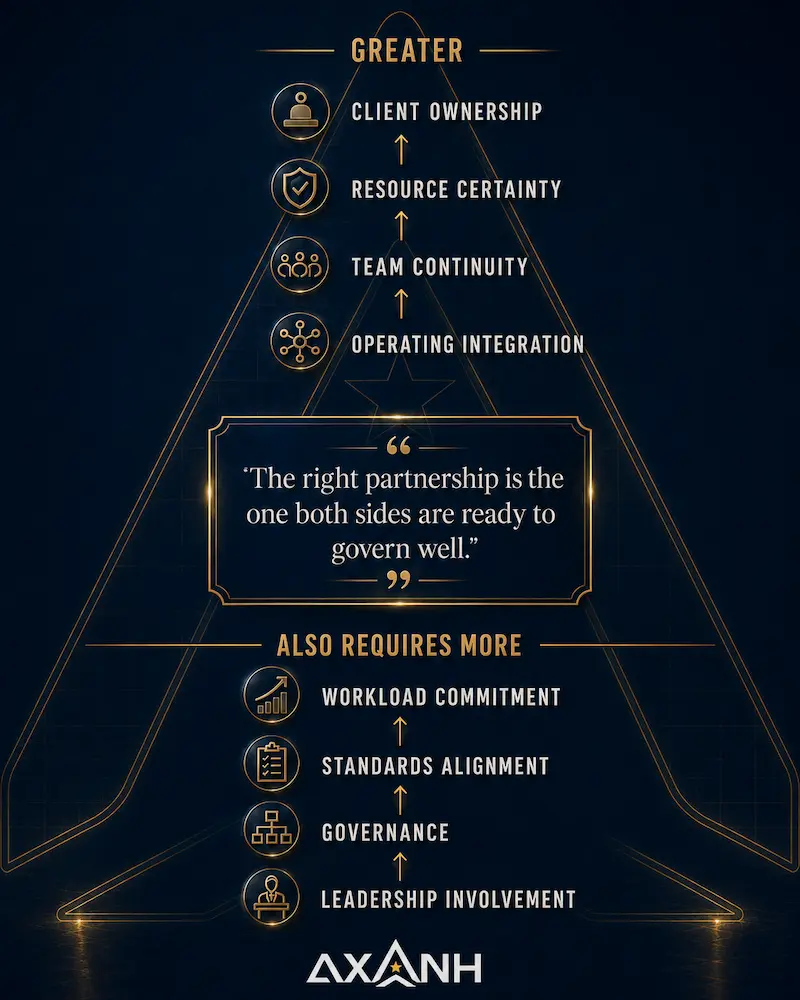
Partnership depth increases both the potential for continuity and the operating responsibility required to sustain it.
Partnership Pathways
Three pathways fit different operating conditions
These pathways are not a ladder. Partnership Fit uses the same public relationship choices to ask a different question: which starting point makes sense for the workload, continuity need and coordination structure your organization has today?
| Pathway | Best suited when | What it prioritizes | What the working model needs |
|---|---|---|---|
| Project Support | Workload is variable, the scope can be bounded clearly and the immediate need is additional delivery capacity rather than reserved long-term continuity. | Responsive support with a lighter coordination structure. | Clear scope, review expectations and practical communication around the defined work. |
| Managed Design Capacity | Work recurs often enough that familiarity with standards, workflows and project context begins to create meaningful operating value. | Greater team familiarity, continuity and a repeatable working rhythm across assignments. | More visible demand, stronger standards alignment and a dependable review and communication rhythm. |
| Long-Term Global Team Pathway | Continuity is strategically important and both organizations have enough workload visibility, governance and leadership capacity to support a closer working structure. | Longer-term continuity and a stronger basis for team and resource planning. | Clear standards, sustained management attention, workable governance and mutual commitment over time. |
The model name is not the decision. The decision is whether the operating conditions make that model useful and sustainable now.
Partnership Fit Check
Check fit before adding operating complexity
This is not a scoring test. The five questions are designed to show where the current operating environment supports a closer relationship and where a simpler starting point may be more practical.
The useful result is a clearer starting point, not a higher partnership level.
How predictable is the workload over the next planning period?
Highly variable demand often makes flexibility more valuable. When recurring work becomes visible enough to plan around, continuity can begin to justify a more stable working structure.
Where does continuity create real operating value?
Consider whether the work benefits from retaining standards, project context, terminology and working knowledge over time. If each assignment is largely independent, the value of long-term continuity may be lower.
Are standards and review expectations clear enough?
Templates, naming conventions, examples, review expectations and communication norms make distributed work easier to operate. If those foundations are still changing significantly, clarifying them may create more value than increasing integration immediately.
Are working responsibilities and decision paths clear enough?
Working responsibilities, review expectations, decision paths and escalation routes should be clear enough for people to understand how work moves, where questions go and how unresolved issues are raised during delivery.
Can both sides sustain the required management attention?
Onboarding, standards transfer, access, communication and review all require management time. The relationship should not depend on more coordination than either organization can maintain consistently.
Progressive Disclosure
Detail should deepen as the decision becomes real
The website should help a client understand the decision framework. The operating model becomes more specific only as the conversation moves from fit assessment into a qualified opportunity, discovery and proposal design.
Website: three public pathways and four decision axes. Fit discussion: five diagnostic questions. Qualified opportunity: specific model recommendations. Discovery or NDA: deeper model architecture. Proposal: responsibilities, governance and commercial structure.
Public clarity first. Specific configuration only when the business context is real enough to make that detail useful.
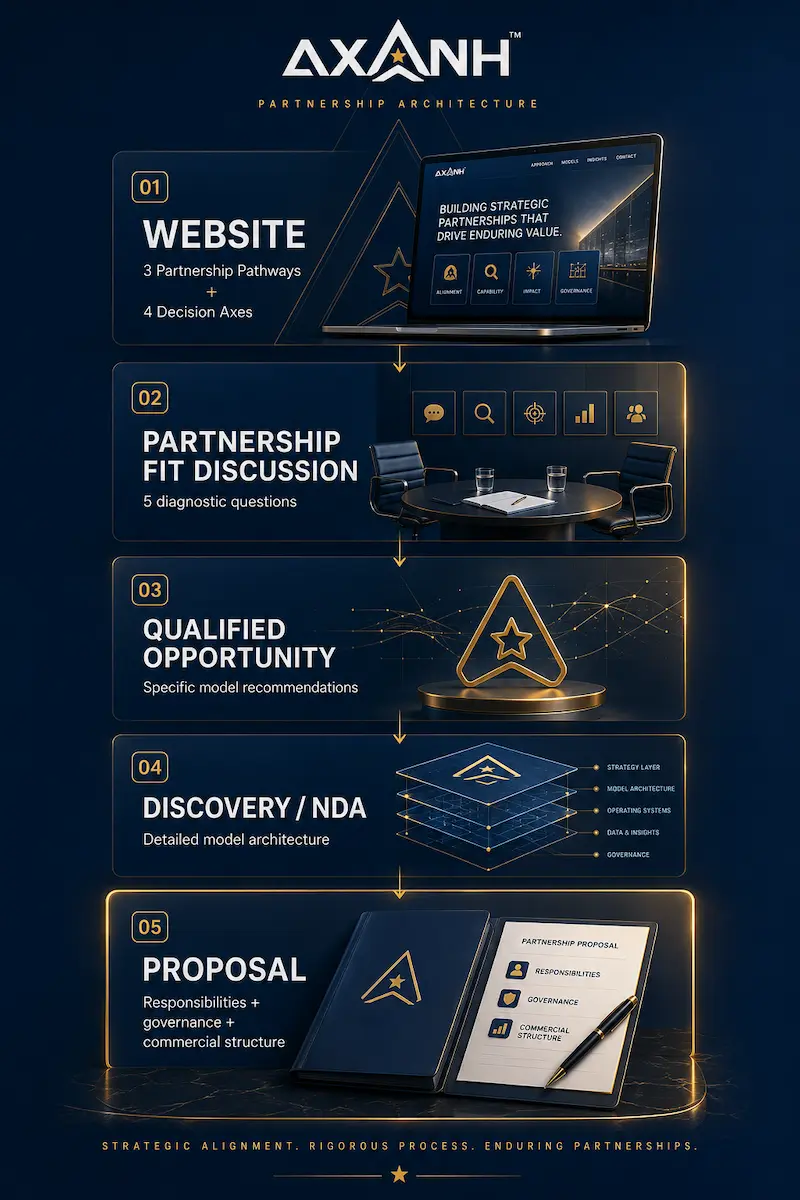
AXANH separates public decision guidance from the more detailed model, governance and commercial discussions that follow qualification.
What We Clarify Together
The right structure depends on the real operating environment
A useful fit discussion looks at the work itself, not only the partnership label. AXANH and the client can clarify the conditions that matter before choosing how much continuity and integration the relationship should carry.
Workload and continuity
What type of work is recurring, what remains variable and where would retaining project or standards context create meaningful value?
Standards and review
What does the team need to understand before starting, and how should standards, examples, reviews and feedback move between the two organizations?
Coordination and decision paths
How should communication, working responsibilities, review expectations and escalation routes be organized so the relationship remains clear as it grows?
The Objective
Choose a starting point both sides can support
The aim is not to maximize integration. It is to find a structure that matches the current work, creates the continuity that is genuinely useful and does not require more coordination than the two organizations can sustain.
Start with fit. Let the relationship evolve when the work provides a reason to do so.
Operating Foundations
Three foundations support a long-term working relationship
Partnership fit is a decision framework. Its value is stronger when the operating environment behind the relationship also supports people continuity, recurring capability development and responsible technology.
People Foundation
Recognized workplace quality
AXA Engineers—the engineering heritage behind AXANH—was ranked #1 in the Small Category on the Best Workplaces in Vietnam™ 2025 list by Great Place To Work®.
Capability Foundation
Recurring capability development
Each year, every eligible AXANH engineer with at least 12 months of tenure enters the Civil 3D Completion assessment cycle organized on-site. This creates a recurring capability checkpoint rather than relying on one-time training.
Technology Foundation
Responsible software governance
For commercial project delivery, AXANH commits to using only genuine, legally licensed and appropriately authorized software, supported by controlled procurement and license-management practices.
Next Step
Find a sensible starting point
A strong partnership does not need to begin with the deepest level of integration. Start with the continuity and working structure that match your current needs, then evolve the relationship when the work and operating conditions support it.