







Founder dependency rarely looks like a problem at first. In a growing AEC firm, it often looks like excellent leadership.
The founder, principal or senior leader knows the clients, understands the standards, recognizes risk quickly and can resolve uncertainty faster than almost anyone else. As the firm wins more work and adds more people, the natural response is to keep bringing the most important questions back to that person.
Over time, however, the same strength can become an invisible queue. Critical decisions wait. Quality judgments move upward. Client escalations return to the same few leaders. Important context remains difficult to transfer. More people increase delivery capacity, but they may also create more coordination for the people already carrying the greatest decision load.
The issue is not whether the founder remains important. Strong leadership should remain influential. The issue is whether the organization can make sound decisions, maintain quality and respond to delivery pressure without requiring one person to carry every critical point of judgment.
Founder Dependency Is Not Simply a Delegation Problem
Delegating more work does not necessarily create a less founder-dependent organization.
A project manager may coordinate delivery while still needing senior approval for every exception. A technical lead may review the work while relying on unwritten standards held by one principal. Account managers may communicate with clients, yet important conversations still return to the founder whenever risk or uncertainty increases.
In those situations, activities have been distributed, but authority, judgment and organizational knowledge have not.
That makes this less a question of personal delegation and more a question of operating model design.
A scalable AEC firm needs to determine how decisions move, how risks become visible, how quality is protected, how knowledge survives beyond individual memory and how issues reach the appropriate level of leadership.
Five Signs Founder Dependency Has Become an Operating Constraint
Founder involvement is not inherently unhealthy. In many firms, it protects technical standards, strengthens important relationships and provides valuable judgment when the stakes are high.
The distinction becomes clearer when we examine what happens when workload and complexity increase.
- Decisions routinely wait for one person. Teams may have responsibility for delivery but insufficient authority to resolve ordinary exceptions, interpret boundaries or make time-sensitive trade-offs.
- Quality depends heavily on final personal review. A senior leader becomes the principal mechanism for catching routine inconsistencies rather than one part of a broader QA/QC architecture.
- Client confidence is concentrated in one relationship. Strategic communication, difficult conversations and important commitments repeatedly return to the founder or principal.
- Critical knowledge travels informally. Client standards, design rationale, previous decisions and lessons learned remain in conversations or individual memory rather than in systems another qualified person can use.
- Escalation becomes the default workflow. Questions move upward not because their consequences justify senior attention, but because ownership, authority or acceptable boundaries remain unclear.
Any one of these patterns may be manageable in a small firm. Together, however, they can create a structural bottleneck as project volume, client expectations and organizational complexity increase.
A Five-Layer Governance Framework for Reducing Founder Dependency
Reducing dependency does not require removing senior leadership from delivery. It requires making good judgment more transferable while reserving senior attention for the decisions where it creates the greatest value.
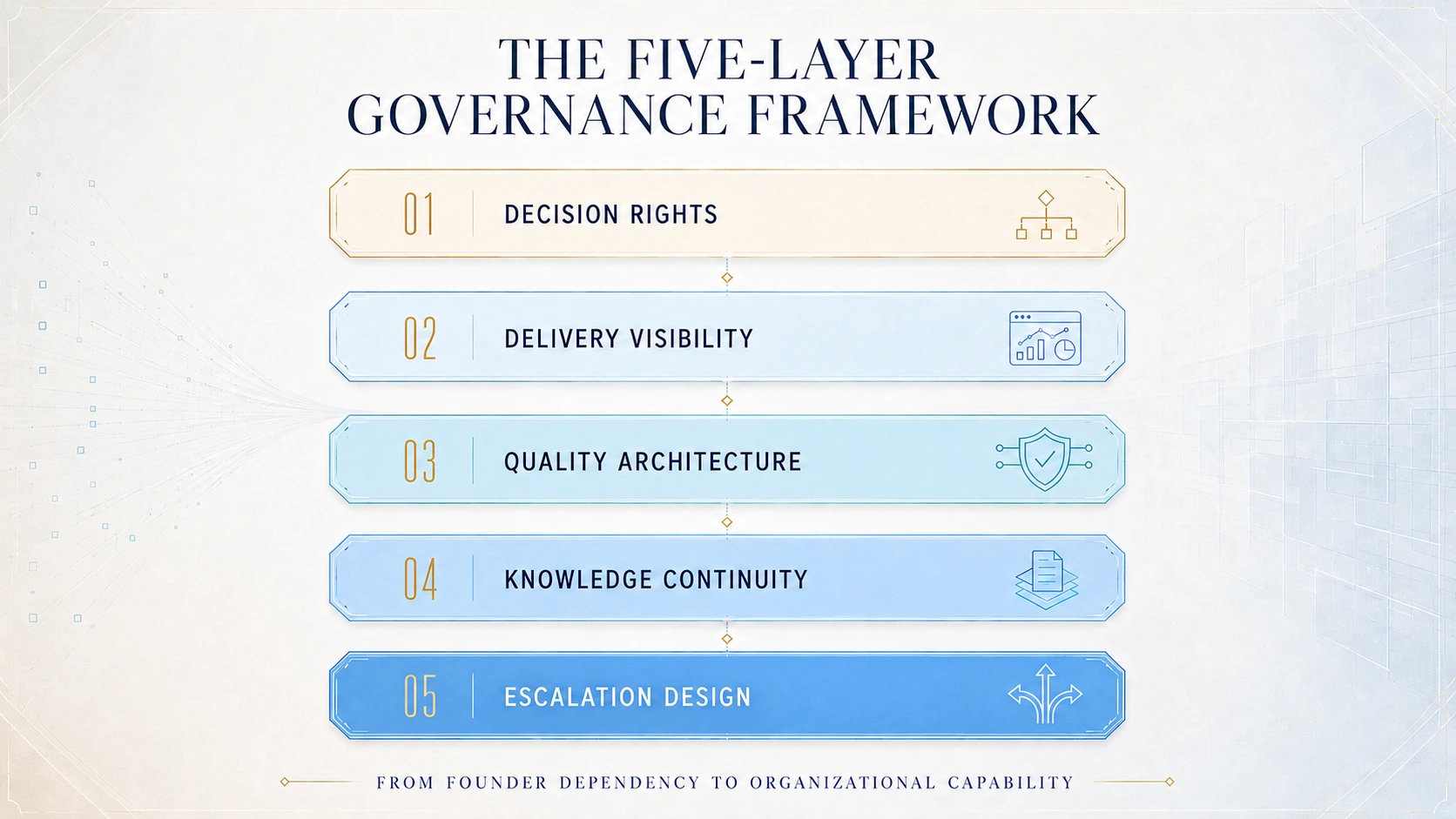
1. Decision Rights
Teams need more than job descriptions. They need to understand what they are actually authorized to decide.
In an AEC delivery environment, this may include decisions involving technical interpretation, design coordination, client standards, schedule priorities, minor scope adjustments, resource allocation or the handling of routine design exceptions.
A useful decision-rights structure clarifies:
- who owns the decision;
- whose input is required;
- what operating or technical boundaries apply;
- which conditions trigger escalation;
- when client consultation is required;
- the expected decision timeframe.
This principle is consistent with established project governance thinking, where accountability, responsibilities and decision-making structures are deliberately defined rather than left to informal interpretation.
Without clear boundaries, capable people may still wait for approval because making the wrong decision appears riskier than delaying the work.
The objective is not maximum decentralization. Some technical, commercial and client decisions should remain with senior leadership. The objective is to make authority intentional rather than accidental.
2. Delivery Visibility
Founder dependency often persists because senior leaders do not trust the information available to them.
A project marked “green” can still contain unresolved design questions, late client inputs, coordination gaps, QA concerns or decisions approaching a critical deadline. When reporting does not expose these conditions, leadership has a rational reason to enter the workflow and inspect the details personally.
A scalable delivery model provides another option: enough visibility to govern without continuously intervening.
Leadership should be able to see:
- what has been completed and what is approaching its next milestone;
- which technical or coordination questions remain open;
- which client decisions or inputs are pending;
- where agreed standards or QA gates have not yet been satisfied;
- who owns each corrective action;
- which issues could affect scope, schedule or client commitments;
- when each material issue will return for review.
The best reporting system is not the one with the most data. It is the one that makes risk, ownership and next action visible early enough for the organization to respond.
3. Quality Architecture
When routine quality depends on one senior person’s final review, dependency has entered the quality system itself.
Senior technical judgment remains essential in AEC work, particularly where unusual risks, complex interpretations or professional responsibilities are involved. But senior review should not be the primary mechanism preventing ordinary production errors from reaching a client milestone.
A stronger quality architecture moves control upstream through:
- defined QA/QC gates;
- discipline-specific checklists;
- peer and technical review responsibilities;
- client-specific design standards;
- release criteria;
- back-check procedures;
- clear exception handling.
This does not dilute professional responsibility or any required licensed review. It ensures that routine quality is supported by the operating system rather than depending primarily on one person’s memory and availability.
The result is a better use of senior expertise: leaders can concentrate on high-consequence judgments, unusual technical risks and strategic alignment instead of repeatedly discovering issues that a stronger process should have surfaced earlier.
4. Knowledge Continuity
Every established AEC firm accumulates valuable institutional knowledge.
It may include how a particular client applies a standard, why a previous design decision was made, what reviewers consistently look for, which project conditions create unusual risk or how a successful delivery sequence has evolved over time.
If that knowledge remains primarily in the founder’s or principal’s memory, the organization must repeatedly return to the same person for context.
Knowledge continuity requires more than storing files. It requires preserving enough reasoning for another qualified person to understand how future decisions should be approached.
- What client or technical standard applies?
- Why does that standard or practice exist?
- Where is professional judgment required?
- Which exceptions require additional review?
- What important decisions should be recorded for future teams?
- What lessons from previous projects should influence the next one?
- Who is responsible for keeping the guidance current?
Useful tools can include client design kits, decision logs, lessons-learned records, technical playbooks, review checklists and maintained standard libraries.
The goal is not to document every conversation. It is to preserve the context on which future judgment depends.
5. Escalation Design
Escalation is not a failure. Unclear escalation is.
Teams should know the difference between a routine production issue, a technical risk, a matter affecting a client commitment, a commercial decision and an issue that genuinely requires principal-level judgment.
A mature escalation path answers four practical questions:
- What threshold requires escalation?
- Who should receive the issue first?
- What information and recommendation should accompany it?
- How quickly is a decision required?
Where appropriate, escalation criteria can also distinguish between technical impact, schedule impact, commercial exposure, client relationship risk and regulatory or professional concerns.
Good escalation design protects leadership attention. Minor uncertainty does not travel unnecessarily upward, while material risks become visible before they are difficult or expensive to correct.
What Changes When an AEC Firm Becomes Capability-Led?
| Operating Dimension | Founder-Dependent Firm | Capability-Led Firm |
|---|---|---|
| Decision-making | Important and routine exceptions frequently wait for the founder or principal | Authority, boundaries and escalation paths are explicit |
| Quality | Consistency is protected primarily through final personal review | Quality is built into staged controls, accountable roles and appropriate senior review |
| Visibility | Leadership obtains confidence by asking for updates and inspecting detail | Risks, decisions, ownership and next actions are visible through a consistent operating cadence |
| Knowledge | Critical context remains concentrated in individual memory | Standards, decisions, rationale and lessons learned are accessible and maintained |
| Client confidence | Trust depends heavily on one senior relationship | Trust is supported by coordinated account, technical and delivery leadership |
| Growth response | Add people and increase senior oversight | Add capability within an established governance structure |
Why Adding More People Does Not Automatically Reduce Dependency
When delivery pressure increases, hiring more people or adding external support is a logical response. It may increase available hours, but it does not automatically create a more scalable organization.
If authority remains centralized, every additional contributor can generate more coordination, questions, handoffs and review for the same small group of leaders.
This is why capacity and capability should be treated differently.
Capacity is the amount of work an organization can theoretically perform.
Capability is the organization’s ability to perform that work consistently, visibly and responsibly within agreed standards.
A scalable delivery model needs both.
Adding capacity without corresponding governance may increase activity while also increasing management load. Adding capability means the additional capacity arrives with appropriate roles, standards, QA responsibilities, communication rhythms, knowledge and escalation paths.
The same principle applies when a firm extends its delivery capacity externally.
The strategic question is not simply:
“How many additional people can we add?”
It is:
“How will this additional capacity operate inside our wider delivery system?”
That question changes the conversation from headcount to operating capability.
Leadership Does Not Disappear When Dependency Declines

Reducing founder dependency does not mean making the founder less relevant.
It means moving leadership attention toward the areas where experience and judgment create greater organizational leverage.
Instead of approving every exception, senior leaders can define stronger decision principles and operating boundaries.
Instead of personally checking every deliverable, they can strengthen the quality architecture and determine where senior technical judgment is genuinely necessary.
Instead of holding every important client relationship alone, they can develop broader account relationships supported by appropriate technical and delivery leadership.
Instead of repeatedly resolving the same category of problem, they can ask a more valuable question:
Why does the organization keep generating this problem, and what should change in the system?
The transition is therefore not from leadership to absence.
It is from personal control to designed control — and from being required everywhere to being most influential where leadership matters most.
Questions for Diagnosing Founder Dependency
A leadership team does not need to begin with a large transformation program. A useful first step is simply to examine where work stops, where information disappears and where authority becomes uncertain.
- Which decisions stop when one senior person is unavailable?
- Which project or client decisions are escalated repeatedly even though they follow recognizable patterns?
- Which quality expectations are understood by experienced people but difficult to transfer to the next team?
- Where does the team carry responsibility without sufficient authority?
- Which client relationships depend too heavily on one individual?
- Which recurring escalations indicate a missing standard, unclear boundary or insufficient training?
- Which important decisions are made correctly today but leave little record for the next project?
- What information would allow leadership to maintain confidence without entering every workflow?
- If the firm added significantly more delivery capacity tomorrow, where would the operating model become strained first?
These questions turn an abstract leadership concern into an operating diagnosis.
The answers reveal where individual expertise has not yet been converted into shared organizational capability.
From Personal Excellence to Organizational Capability
Many successful AEC firms are built through extraordinary founder involvement.
That involvement establishes the quality bar, protects important client relationships, develops institutional knowledge and defines how the organization approaches difficult work.
The challenge appears when continued growth requires the same individual involvement to be repeated across an increasingly large number of people, projects and decisions.
The next stage is not to remove the founder’s influence. It is to embed the best of that influence into the organization itself.
That requires explicit decision rights, reliable delivery visibility, built-in quality controls, maintained organizational knowledge and disciplined escalation.
When those systems strengthen, growth no longer has to mean adding more decisions to the founder’s workload.
Leadership remains influential. Standards remain protected. Client relationships remain important.
But the organization develops a greater ability to act responsibly, maintain quality and absorb additional capacity without requiring continuous personal intervention at every critical point.
That is the transition from a founder-powered firm to a capability-led organization.
Scale Delivery Without Centralizing Every Decision
When AXANH extends an AEC firm’s design capability, the objective is not simply to add disconnected headcount. We align people with clear roles, shared standards, QA responsibilities, delivery visibility and escalation paths — so additional capacity can become part of a stronger operating system.
