



Partnership Models
Partnership Fit
Strategic Partnerships
Why AXANH
Discuss Your Needs




How We Work
Additional capacity only works when coordination stays clear
When an external engineering team enters your delivery workflow, capability is only part of the question. How is context transferred? How are standards learned? Who decides? When are risks raised? Where is work reviewed before handoff?
AXANH’s engineering outsourcing process organizes these points through a deliberate operating rhythm: alignment, onboarding, coordination, review, handoff and adaptation. Client-specific SOPs and continuous learning help the team retain what has already been clarified instead of rebuilding the same context from the beginning.
Behind those mechanisms is a simple objective: the way we work should help our clients succeed.
Before Work Begins
What does the team need to start well?
Which outcomes, standards, access and project context matter most at the beginning?
How does knowledge stay with the team?
Do recurring clarifications and lessons become shared working knowledge, or remain with individual people?
Where do open questions go?
Who can decide, who needs to be consulted and when does an issue need escalation?
Where is quality reviewed?
How is review built into the workflow before work reaches handoff?
The Management Question
More people should not create another management system
Additional engineering capacity can help with workload. But if client managers must repeatedly rebuild context, find decision owners, correct preventable issues or recover information after every handoff, the extra capacity arrives with a substantial coordination cost.
Our operating approach focuses on the points where distributed delivery most easily creates friction: defining the outcome, transferring the context that matters, retaining useful knowledge, clarifying decision paths, raising concerns while there is still time to act and placing review close to where the work is produced.
The aim is not to remove coordination. It is to make coordination create clarity rather than become a second layer of work.
Context
Do not rebuild context
Standards, terminology, working assumptions and useful clarifications should remain accessible to the people who need them instead of being explained again for every assignment or every new team member.
Decisions
Do not let questions sit
A small question can become a delay when no one knows who has authority to answer it. Decision rights and escalation paths need enough clarity for important issues to keep moving.
Learning
Do not isolate lessons
A clarification, review comment or better way of working creates more value when the lesson can be reused by the team instead of remaining only with the person who encountered it.
Operating Flow
Six points keep the work moving clearly
Every engagement has a different scope and level of governance. The operating system still needs to answer the same practical questions: what are we trying to achieve, what does the team need to know, how do decisions move, where is quality reviewed, what context must survive handoff and when should the system adapt?
01 · Align
Clarify the outcome
Define the expected result, scope, deliverables, assumptions, boundaries and responsibilities that need to be clear before production accelerates.
02 · Onboard
Transfer the context
Bring the right standards, templates, terminology, access and review expectations to the people who need them for the work.
03 · Coordinate
Keep decisions moving
Give open questions, progress updates, decisions and material risks a clear owner, path and level of visibility.
04 · Review
Review within workflow
Place quality review close enough to production that issues can be identified before they become downstream rework or client review burden.
05 · Handoff
Carry the reasoning forward
Keep important decisions, assumptions, review context and useful lessons with the work so the next person is not forced to reconstruct them.
06 · Adapt & Scale
Change when the work changes
As workload, continuity or complexity grows, communication, knowledge transfer, governance and resource planning can mature with it.

Clarity Before Velocity
Start with the outcome and the context that matters
A strong start does not try to collect every document that exists. It prioritizes the information that would materially change how the work is produced, reviewed or handed off if the team misunderstood it.
Clarify before production accelerates
Scope should be specific enough for the people doing the work to understand the expected outcome, deliverables, assumptions and relevant boundaries. Uncertainty is more useful when it is visible early than when each person silently fills the gap with a different assumption.
Onboarding is context transfer
Accounts and introductions are administrative steps. The more important work is transferring the terminology, examples, relevant access, review expectations and operating context the team needs to make appropriate decisions.
Standards need to be understood
Sending a standards folder is not the same as transferring standards. The team needs to understand where a standard applies, what it changes in the work and when a question should be raised instead of resolved by assumption.
Good onboarding does not make the team know everything on day one. It makes the important context, open questions and knowledge gaps visible.
SOP & Improvement
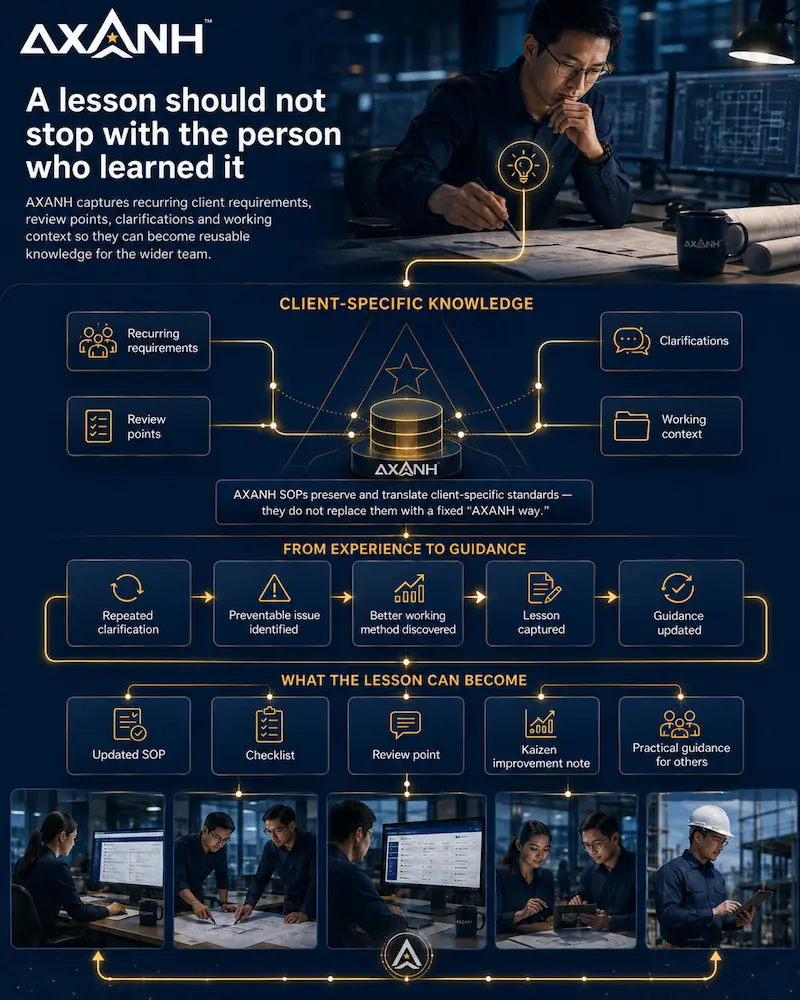
A lesson should not stop with the person who learned it
AXANH builds and maintains client-specific internal SOPs so recurring requirements, review points, clarifications and working context can become knowledge the wider team can use.
These SOPs do not replace a client’s standards with a fixed “AXANH way.” Their role is to translate agreed requirements and recurring lessons into clearer working guidance for the next cycle of work.
When a question has been clarified repeatedly, a preventable issue has been found or a better working method emerges, the lesson can become an updated SOP, checklist, review point, Kaizen improvement note or practical guidance for others.
Knowledge continuity begins when individual experience can become shared capability.
Weekly Learning Rhythm
Improvement belongs to the team
Every team member has a recurring weekly responsibility to contribute to the team’s operating knowledge. That can mean writing or improving an SOP for a common task, recording a clarification, documenting a Kaizen improvement, strengthening a checklist or turning a useful experience into guidance another person can apply.
Not every suggestion automatically becomes a new standard. Changes that affect client requirements, scope, quality expectations or decision intent still need the appropriate review and confirmation.
The Learning Loop
Capture, document, improve, reuse
Capture: recognize recurring questions, clarifications, review comments, preventable issues and better working methods that are worth retaining.
Document: turn repeatable knowledge into an SOP, checklist, example or review point so it does not depend entirely on individual memory.
Improve: use Kaizen to identify practical friction, unclear steps and opportunities to make the work easier to understand or repeat.
Reuse: return the learning to the team so later onboarding, production and review can begin from a stronger point.
Client-specific knowledge remains controlled. Full SOPs, client standards, controlled templates, access information, confidential QA/QC details and protected intellectual property are not treated as public marketing material.
Decisions & Visibility
Decisions need a path; information needs the right owner
Distributed work does not become slow simply because people are far apart. A question can sit unresolved because no one knows who has authority to answer it, who should review it or when it has become important enough to escalate.
A working relationship needs to distinguish the person doing the work, the person reviewing it, the people who hold relevant context and the person with authority to change direction or scope. Authority and accountability should not drift apart.
Decision
Who can decide?
Separate decisions that can be resolved within the current scope from those that require another decision owner.
Consult
Who should be consulted?
Bring in the people who hold the relevant context, standards or responsibility before an important direction changes.
Review
Who should review?
Place review responsibility close enough to the decision or deliverable that the reviewer can act while the work is still moving.
Escalate
When should it move up?
Issues with material implications for scope, quality, schedule, standards or client intent need an appropriate escalation path.
Good communication is not the same as more meetings
Communication is useful when it reduces uncertainty. Frequency and format should reflect the scope, the number of people involved and the decisions that need to remain visible. The important question is whether the right people receive the right information early enough to act.
Raise risk while there are still options
An early concern may be incomplete, but it is often more useful than a polished explanation after the issue has already affected delivery. Not every small issue requires escalation; material concerns need a path that matches their potential impact.
Quality & Continuity
Review belongs inside the workflow, not at the rescue stage
AXANH applies a three-layer quality framework—Self-Check, Peer Review, and Manager Review—to strengthen delivery consistency. The depth and configuration of review depend on the type of work, agreed scope and responsibilities.
The purpose is not to create approval layers for their own sake. Review should keep quality responsibility close enough to production that issues have a chance to be identified before they become downstream rework or client review burden.
01 · Self-Check
Check at the source
Quality responsibility begins with the person producing the work. Self-Check creates the first review point before the work moves to someone else.
02 · Peer Review
Add another perspective
A second reviewer can challenge assumptions, details or inconsistencies that are harder to notice when someone has been working closely with the same material.
03 · Manager Review
Match review to responsibility
Manager Review adds the appropriate management layer for the type of work and responsibility rather than assuming every deliverable needs the same review depth.
Handoff
A good handoff carries the reasoning with the work
Files can be complete while context is still lost. Important decisions, working assumptions, review history, clarifications and lessons that may affect the next step should remain accessible to the people who continue the work.
This matters even more in recurring work. If each assignment begins by rebuilding the same context, continuity cannot produce its full operating value.
Handoff completes a phase. A knowledge system allows what the team has learned to keep creating value after that phase is finished.
Start at the Right Scale
Start at a scale that creates useful learning
Not every engagement needs to begin with a large structure. When the work allows it, a clearly defined assignment or workstream can create enough real operating context for both organizations to understand how they work together.
The value of an initial phase is not limited to the deliverable. It can reveal which standards need more context, which questions recur, which review points create value and which parts of the workflow should become clearer SOP guidance or be improved.
If workload, continuity and operating dependency increase, the working model can mature with them. Communication rhythm, knowledge transfer, resource planning and governance should be added when they solve a real need rather than because a larger structure sounds more sophisticated.
Scale should follow the clarity and knowledge created through real work.
What an Initial Phase Can Reveal
What should become clearer?
Standards: what is understood and what still needs context.
Questions: which clarifications recur and should be retained.
Review: which checkpoints genuinely help the work.
Knowledge: which lessons should become SOP guidance, a checklist or a Kaizen improvement.
Governance: whether the current operating structure is enough or should mature.
Client Success
The process is useful only if it helps the client move forward
SOPs, reviews, communication, Kaizen and governance are means, not the destination. Their value depends on whether they help the team understand what the client is trying to achieve and contribute more effectively to that outcome.
AXANH expects its people to do more than complete the basic task: understand the purpose of the work, identify relevant risks, communicate clearly and suggest practical improvements when professional judgment and the agreed scope allow.
Helping a client succeed does not mean promising beyond what can be delivered or expanding responsibility without agreement. It means using capability, judgment and disciplined working systems to make a meaningful contribution while keeping scope, authority and boundaries clear.
Our most important objective is to help our clients succeed. That is why AXANH invests in how the work is organized, not only in how many hours can be supplied.
What Client Success Changes
The question is bigger than “Is the task done?”
Outcome: what result is this work meant to support?
Risk: is there something the client should know while there is still time to respond?
Judgment: is there a clearer, more effective or more maintainable way forward within the current responsibility?
Learning: what lesson should be retained so the team does not pay the same learning cost again?
Continuity: what can make the next cycle of work better than this one?
Mutual Clarity
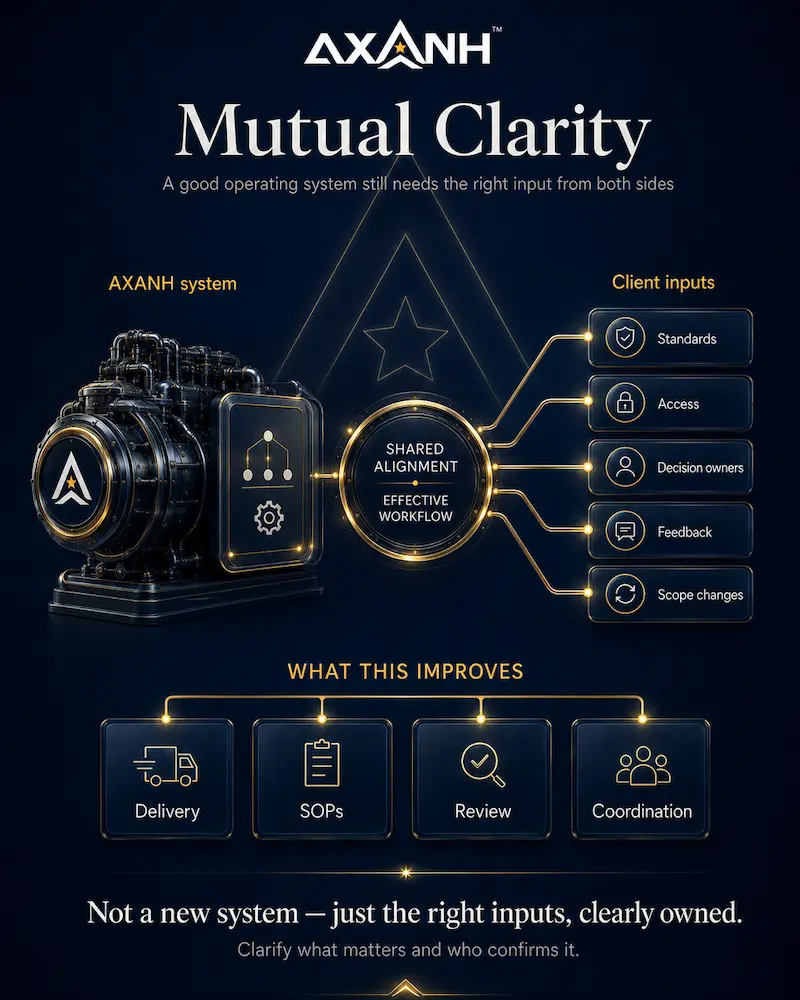
A good operating system still needs the right input from both sides
Delivery, SOPs, review and coordination work better when important dependencies also have a path: current standards, relevant access, decision owners, timely feedback and changes that may affect scope or direction.
This does not mean a client needs to build a new management system before working with AXANH. It means identifying the inputs that genuinely matter and clarifying who can provide or confirm them.
What does AXANH need to begin a new scope?
The exact inputs depend on the work. A useful starting point usually includes a sufficiently clear outcome and scope, relevant standards or references, necessary access, key contacts and a path for questions that may affect direction or review.
Do AXANH SOPs replace client standards?
No. Client-specific SOPs help AXANH structure the requirements, standards, clarifications and lessons needed for repeatable delivery. They do not independently change client standards, project requirements or agreed responsibilities.
Does AXANH publish its full internal SOP library?
No. Full SOPs, client-specific standards, controlled templates, confidential QA/QC details, access logic and protected intellectual property remain controlled unless a specific item is approved for external use.
Does a client need to change its existing workflow?
Not necessarily. The first job is to understand how the work needs to operate in the client’s environment and identify the points that require alignment. A workflow should change only when there is a clear operating reason to change it.
Common Questions
Questions teams often ask before starting
Does AXANH use the same workflow for every engagement?
No. The principles around clarity, standards, responsibility, knowledge sharing, communication and review can remain consistent while the operating detail changes with the scope, workload, type of work and level of continuity required.
Must every standard be fully documented before work begins?
No. The standards that materially affect the scope should be clear enough to begin responsibly, while onboarding and real work can reveal areas that need further clarification. The aim is not to turn onboarding into a documentation project before production can start.
How are SOPs and Kaizen improvements updated?
AXANH places improvement responsibility on the team. Recurring tasks, clarifications, review comments, lessons and practical improvement opportunities can become new SOP guidance, updates to existing guidance, checklists or Kaizen notes. Changes affecting client requirements or agreed responsibilities still require the appropriate review.
When does an engagement need more governance?
Governance usually needs to mature as workload, continuity, the number of participants, access requirements, resource commitment or the volume of decisions increases. The right structure is enough to keep responsibility and information flow clear without creating more ceremony than the work needs.
Do we need to begin with a long-term engagement?
No. The starting point should fit the actual scope and operating context. A clearly defined assignment or workstream can sometimes give both organizations enough experience with standards, communication, review and knowledge transfer to decide whether greater continuity would be useful.
Talk With Leadership
Start with the outcome you need to achieve
If the question is strategic—capacity, standards, operating fit, continuity or how a global engineering relationship should begin—you can discuss the context directly with Anthony, CEO of AXANH.
Bring the work as it actually exists today: workload patterns, review pressure, recurring coordination issues, standards or the knowledge you want a team to retain. The purpose of the conversation is to identify a sensible starting point, not to force a larger model than the work requires.