






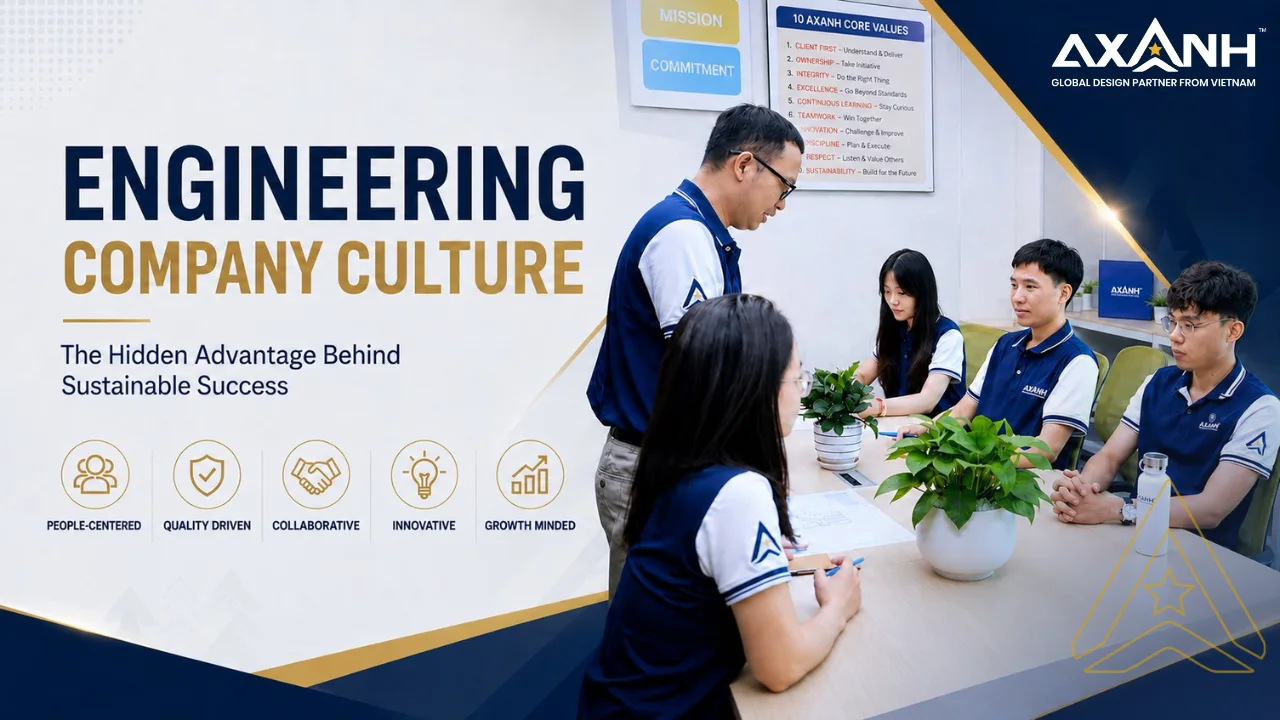
Engineering company culture may seem less visible than technical capability, but it often determines whether trust, quality and continuity can be sustained over time.
When leaders evaluate a potential engineering or design partner, they can examine experience, software, technical disciplines and delivery capacity. Those factors matter. Yet some of the most consequential risks are harder to see at the beginning of a relationship.
Will concerns be raised while there is still time to act? Will quality depend on a repeatable system or on one person working late? Will knowledge be shared across the team? Will people take ownership when something goes wrong? Will growth strengthen the organization, or create greater dependency on a few individuals?
These are cultural questions, but they are also operating questions. A strong engineering company culture becomes visible in the way an organization communicates risk, protects standards, shares knowledge and builds responsibility across its teams.
At AXANH, we use the AXANH Culture House to describe how our values, working philosophy, leadership expectations and shared behaviors connect. It is not designed as an employee handbook or a collection of inspirational statements. It is a model for understanding how culture shapes the way an organization works, grows and creates value for others.
Culture Is an Operating System
Organizational culture is sometimes treated as the softer side of business: important for morale, but separate from delivery, quality and commercial outcomes.
We see it differently.
Culture influences what happens when instructions are incomplete, when a deadline is under pressure, when two professional viewpoints conflict or when a team discovers a problem that may be uncomfortable to report.
Policies cannot anticipate every situation. Processes cannot make every judgment. In the moments where written rules are no longer enough, people rely on the values and behaviors that have been reinforced around them.
A culture that rewards honesty makes early risk communication more likely. A culture that treats mistakes only as personal failures can encourage people to hide them. A culture that values shared learning turns project experience into stronger systems. A culture built around individual heroes may produce impressive short-term rescues while leaving the wider organization fragile.
Culture becomes operational when it consistently shapes decisions, communication and behavior—especially when the easiest action is not necessarily the right one.
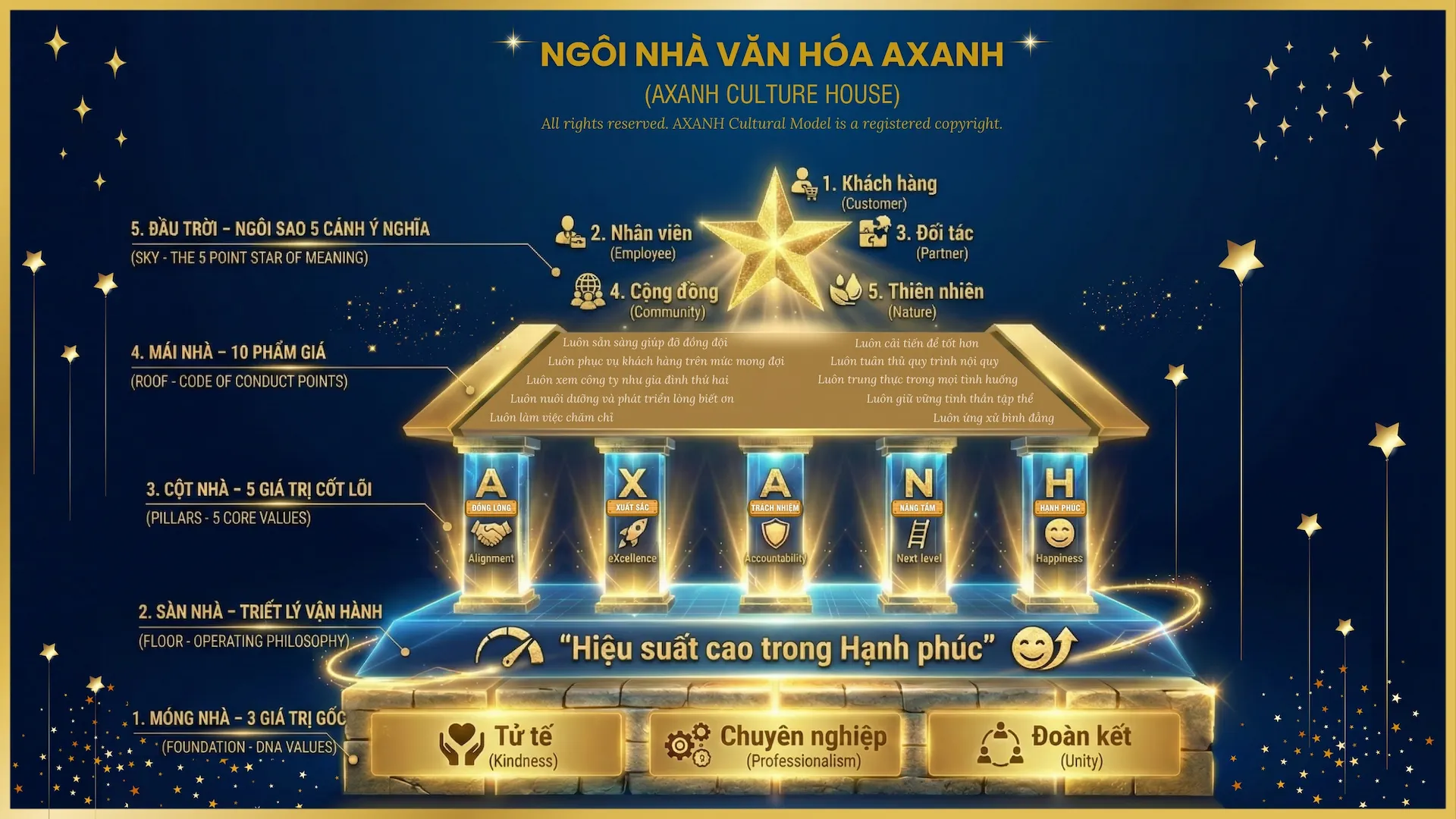
The Five Layers of the AXANH Culture House
The AXANH Culture House is built as one connected structure. No single value or initiative carries the culture alone.
| Layer | Role in the Culture House | Operating Meaning |
|---|---|---|
| The Foundation | Kindness, Professionalism and Unity | The character that guides how people treat others, approach their work and contribute to shared goals. |
| The Floor | High Performance Through Well-Being | The working philosophy that supports strong results without normalizing harmful or unsustainable practices. |
| The Five Pillars | Alignment, Excellence, Accountability, Next-Level and Happiness | The principles used to guide decisions, quality, ownership, learning and sustainable performance. |
| The Roof | Ten Shared Ways of Working | The repeated behaviors that protect culture in daily work. |
| The Sky | The Five-Point Star of Meaning | The wider value AXANH seeks to create for clients, people, partners, community and nature. |
The structure matters because culture weakens when its parts are separated.
Values without daily behaviors remain abstract. High standards without well-being may produce exhaustion, turnover and dependence on rescue work. Well-being without accountability can become a reason to avoid difficult expectations. Client focus without responsible leadership can create pressure that is simply transferred to employees or suppliers.
The Culture House is designed to hold these tensions together.
The foundation: character before slogans
The foundation consists of Kindness, Professionalism and Unity.
Kindness means respect, empathy and honesty. It does not mean avoiding difficult feedback or accepting repeated carelessness.
Professionalism means discipline, quality and responsibility. It is visible in the clarity of an email, the care of a review, the honesty of an early warning and the reliability of a commitment.
Unity means placing the shared outcome above personal ego. It does not require everyone to share the same opinion. Healthy teams need respectful disagreement, professional judgment and the confidence to raise concerns before a decision is made.
Together, these values establish a simple expectation: people should be able to tell the truth, uphold standards and move toward a common purpose without diminishing one another.
The five pillars: principles for decisions and action
- Alignment: One purpose, open discussion and shared action.
- Excellence: Doing work we are prepared to stand behind and continuing to improve it.
- Accountability: Owning commitments, responding to problems and carrying lessons forward.
- Next-Level: Growing personal capability while helping others become more capable.
- Happiness: Creating the energy and conditions required for meaningful, lasting performance.
These pillars are not separate campaigns. They are mutually reinforcing.
Alignment without accountability can result in agreement without follow-through. Excellence without shared learning can make quality dependent on a few experts. Growth without concern for well-being can become unsustainable ambition. Happiness without professional standards is not a complete culture of performance.
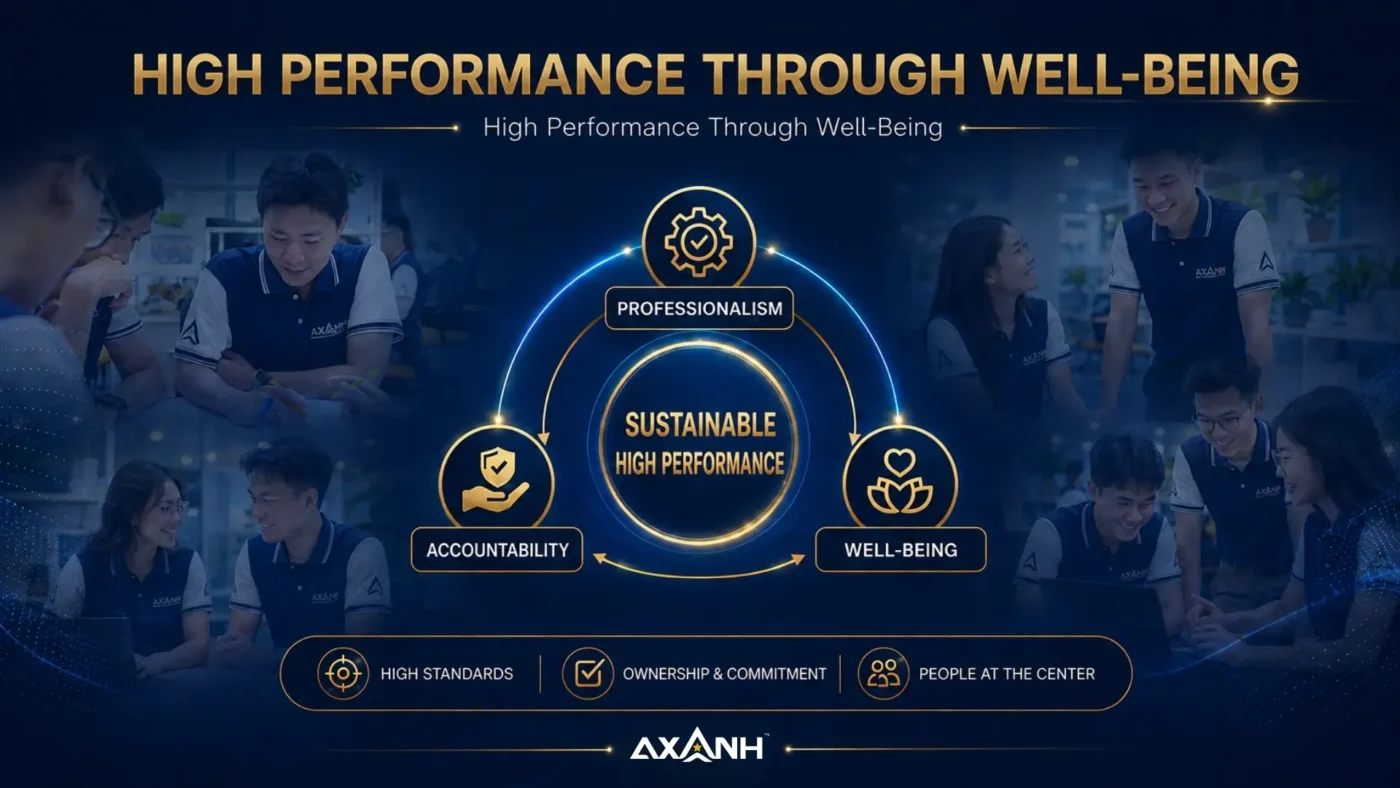
High Performance Through Well-Being
One of the most persistent assumptions in professional services is that high performance requires permanent pressure, unusually long working hours and repeated personal sacrifice.
There are certainly periods when important work requires additional effort. A culture of sustainable performance, however, cannot be built around emergency effort as the normal operating condition.
AXANH does not see performance and well-being as opposing objectives. Well-being is not a reward that begins after performance has been achieved. It is one of the conditions that allows responsible performance to continue.
People are more able to exercise judgment, disclose uncertainty, learn, cooperate and accept responsibility when they feel respected and psychologically safe enough to speak honestly. At the same time, a healthy environment still requires clear expectations, professional discipline and meaningful accountability.
For broader context on healthy work environments, readers may also refer to the WHO guidelines on mental health at work.
What well-being does not mean
Well-being does not mean that every day must be easy. It does not mean avoiding pressure, lowering standards or removing the consequences of repeated carelessness.
It means building an environment where people can:
- ask for support before a problem becomes critical;
- raise risks without fear of unfair blame;
- learn from honest mistakes;
- build healthy working relationships;
- develop a stable and meaningful career;
- work through demanding periods without treating exhaustion as a badge of honor.
What high performance does mean
High performance is not measured by how busy people appear or by who works the latest.
It is demonstrated through reliable work, fulfilled commitments, early problem-solving, responsible use of time and resources, continual improvement and the creation of capability that remains useful after the current assignment ends.
A good result produced through damaging practices is incomplete. A comfortable environment that cannot produce dependable work is also incomplete.
The objective is not to choose one side. It is to create the operating conditions in which high standards and human well-being strengthen one another.
How Engineering Company Culture Becomes Quality, Trust and Continuity
Clients may not see every aspect of an engineering company culture, but they experience its consequences through communication, quality, risk awareness and continuity.
Clear communication
When honesty and professionalism are reinforced, communication becomes more than status reporting. Teams share what decision-makers need to understand, including uncertainty, changing assumptions and emerging risk.
Clarity is not the same as producing more information. It means communicating the right information at the right time in a form that helps others act.
Reliable quality
Quality should not depend on luck, personal heroics or a single experienced individual reviewing everything at the last moment.
A culture of excellence supports preparation, agreed standards, checklists, review discipline, recorded assumptions and lessons that can be reused. The objective is to make good work repeatable and to make preventable mistakes less likely to recur.
For broader context on the relationship between organizational culture and quality, see ISO 10010:2022 guidance on organizational quality culture.
Early awareness of risk
An early warning is a form of professional respect.
Teams that fear blame may delay difficult news. Teams built around accountability are expected to raise concerns while there are still meaningful choices available—and, where possible, to bring potential responses rather than simply transferring the problem.
Stable teams and knowledge continuity
Organizations become fragile when knowledge, relationships and decision-making authority remain concentrated in a small number of people.
Developing people, documenting important lessons and sharing responsibility create greater continuity. The aim is not to make talented individuals less important. It is to ensure their experience strengthens the system around them.
For an engineering company culture to support continuity, knowledge must become increasingly transferable rather than remaining concentrated in individual memory.
Practical improvement
A completed project should leave more than a finished deliverable. It should also leave behind better judgment, stronger processes and knowledge that can improve future work.
When lessons remain with one person, their value is limited. When they become guidance, training, templates or improved checks, they become organizational capability.
Shared responsibility
Shared responsibility does not remove role boundaries or expand scope without agreement. It means that within an agreed role, people think beyond the mechanical completion of tasks.
They ask questions, consider downstream impact, identify risk and remain engaged until issues are properly understood and closed.
Clients should not need access to an organization’s internal culture documents to recognize its culture. They should experience it through clarity, consistency, responsible judgment and the way problems are handled.
Shared Success as a Partnership Principle
Behind the Culture House is a simple principle: success becomes more sustainable when it contributes to the success of others.
This does not mean agreeing to every request, giving without judgment or creating one-sided relationships. A healthy partnership requires clear boundaries, fair expectations and value for all parties.
Shared success asks different questions:
- How can this work help the client become stronger?
- How can the experience help the team become more capable?
- How can the relationship create fair value for both sides?
- How can a lesson prevent the same problem from recurring?
- How can today’s progress create further opportunity tomorrow?
This perspective moves a relationship beyond transactional task completion.
A transactional supplier is primarily evaluated by whether an assigned output was completed. A long-term partner must also consider how communication, standards, learning and continuity influence the client’s wider operating capability.
In this sense, engineering company culture affects partnership quality because it influences how commitments, disagreements, standards and responsibilities are handled when conditions become difficult.
At AXANH, the word partnership describes this operating orientation. It does not automatically imply a legal partnership or equity relationship. It describes a commitment to alignment, shared standards, integrated delivery and long-term value.
Shared Success Extends Beyond the Organization
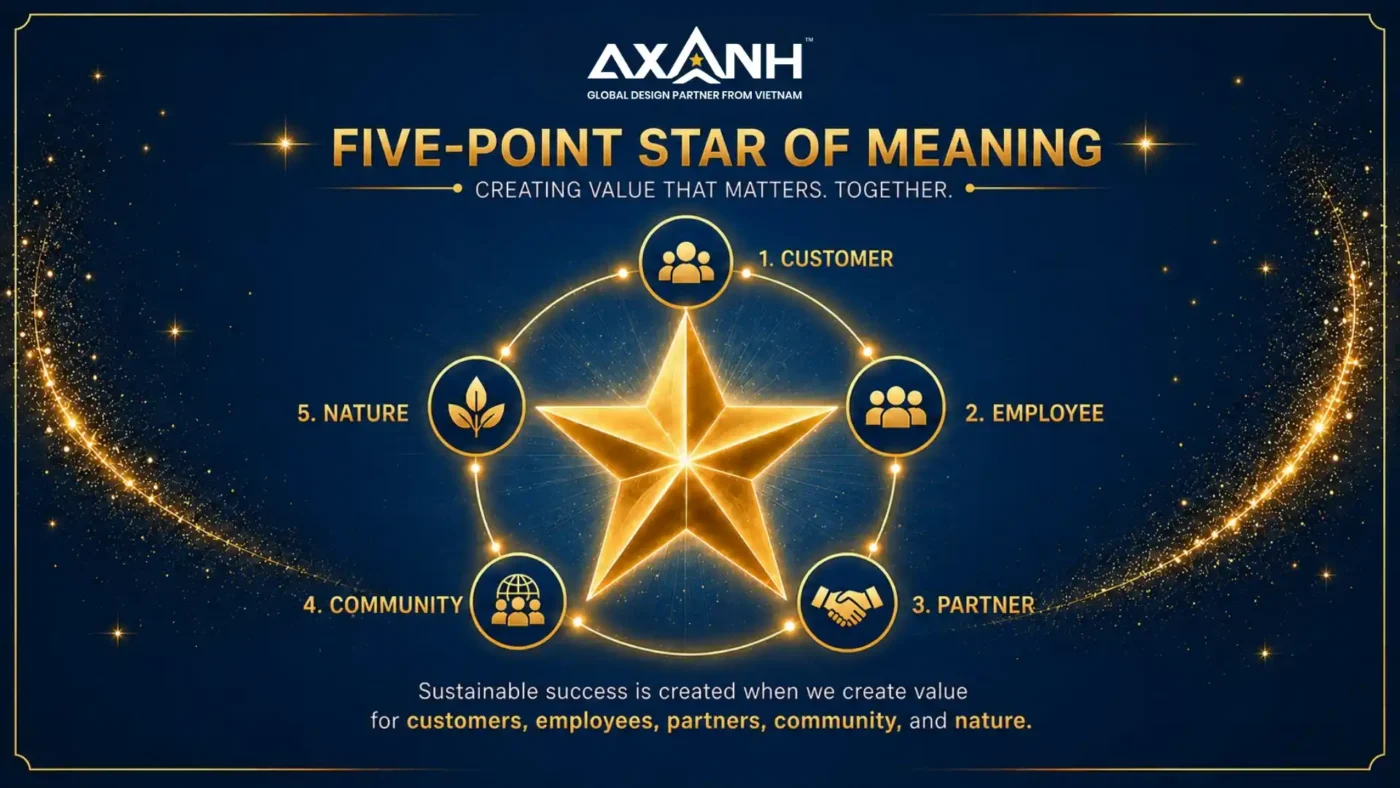
The Five-Point Star of Meaning places five connected stakeholder groups above the Culture House:
- Clients
- Our People
- Partners
- The Community
- Nature
These groups are not separate from organizational success. They are part of the conditions that allow success to last.
When clients become stronger, relationships can become stronger. When people grow, the organization’s capability grows. When partners are treated fairly, the wider delivery system becomes more dependable. When knowledge and opportunities contribute to the professional community, the future talent base can become stronger.
Environmental responsibility adds an important boundary: organizations should avoid presenting intentions as achievements. Claims should be supported by real practices and evidence.
The Culture House therefore rejects a narrow definition of success in which one party benefits through serious and avoidable harm to another.
Leadership Determines Whether Culture Becomes Real
Culture is shaped less by what leaders announce than by what they repeatedly reward, tolerate, question and model.
Leaders influence whether people feel safe to raise a risk, whether feedback is useful or humiliating, whether workloads are planned responsibly and whether improvement becomes a shared responsibility.
For leaders, the practical test of an engineering company culture is therefore not simply whether the organization has defined values. It is whether those values remain visible when teams face pressure, ambiguity and competing priorities.
Within the AXANH Culture House, leaders are expected to:
- set clear goals and priorities;
- explain why the work matters;
- welcome respectful professional disagreement;
- provide honest and timely feedback;
- recognize contribution fairly;
- protect those who raise concerns in good faith;
- manage workloads responsibly;
- develop people instead of creating dependence;
- take responsibility for the environment their teams experience;
- help clients, employees and partners succeed together.
Leadership performance cannot therefore be measured only by the volume of work completed during a leader’s tenure.
It should also be assessed through the capability built, the trust created, the people developed, the problems prevented and the value that remains after the leader is no longer personally directing every decision.
Questions Leaders Can Use to Evaluate Culture
Culture can be difficult to assess from a website or a presentation. Leaders evaluating their own organization—or a prospective partner—can look for operating signals.
These questions can also help decision-makers move beyond surface-level descriptions of engineering company culture and examine the operating conditions beneath them.
| Leadership Question | What It May Reveal |
|---|---|
| How are risks communicated when the message is uncomfortable? | Psychological safety, honesty and escalation maturity. |
| What happens after an honest mistake? | Whether the culture learns, blames or hides problems. |
| Can quality continue when a key person is unavailable? | System strength, knowledge sharing and dependency risk. |
| How are standards maintained during periods of high workload? | Planning discipline and whether overtime is being used as a substitute for management. |
| How do experienced people help others become more capable? | Mentoring, succession strength and long-term continuity. |
| Do teams raise issues with possible responses? | Accountability and practical problem-solving. |
| What remains after a successful project? | Whether success is converted into reusable organizational capability. |
No culture will be perfect, and no organization will demonstrate every desired behavior at all times.
The more useful question is whether the system encourages honesty, learning and responsible correction—or makes problems more likely to remain hidden.
Culture Is the Trust an Organization Earns
At AXANH, engineering company culture is not defined only by what we say about ourselves. It is reflected in the operating choices people make when standards, responsibilities and relationships are tested.
It is reflected in the commitments we keep, the risks we disclose, the standards we protect, the people we develop and the value our work helps others create.
We aim to be kind without avoiding difficult conversations, professional without becoming cold, ambitious without losing balance and united without silencing different perspectives.
We believe high standards and human well-being can strengthen one another. We also believe that lasting success is more likely when clients, people, partners and communities become stronger through the relationship.
Every careful review, early warning, shared lesson and person developed is a contribution to the future capability of the organization.
Some results appear immediately. Others take years to become visible.
The responsibility of culture is to keep creating the conditions from which trust, quality and sustainable growth can continue to emerge.
Explore a More Integrated Model of Collaboration
Discover how AXANH connects disciplined delivery, human-centered development and long-term organizational capability.
