






Civil engineering outsourcing · Trends 2026–2027
In May 2026, ACEC’s Engineering Business Sentiment study put the median backlog at U.S. engineering firms at about 11 months, with 84% of firms carrying at least one open position. In October, ASCE reported the average civil engineer’s base salary had passed $152,000, up more than $8,000 in a year, and described a shortage at nearly every experience level. Those two facts, read together, are the backdrop for every civil engineering outsourcing trend worth watching: more work than people, and people who cost more each year. For how that work is delivered day to day, see our civil engineering outsourcing page.
The civil engineering outsourcing trends shaping 2026 and 2027 are: a capacity gap that is structural rather than cyclical; a shift from buying drafting hours to building long-term design partnerships; AI and automation moving into daily plan production with human review as the control; Civil 3D and model-based delivery becoming the baseline for outsourced work; sharper client expectations on responsible charge, data governance and licensing; and a slow move of outsourcing from a cost decision to a capacity strategy owned by firm leadership.
Median backlog about 11 months; 84% of U.S. engineering firms have at least one open position; 64% expect to hire more.
Shortage at almost all levels of experience; average civil engineer base salary above $152,000, up more than $8,000 in a year.
98% of design and make leaders surveyed use AI; 84% report higher productivity; 59% use or plan agentic AI within a year.
01 · The structural gap
Trend 1: The capacity gap is structural, and firms are planning for it
For most of the past decade, firms treated staffing shortages as a cycle to ride out. The 2026 data suggests otherwise. ACEC’s Q2 2026 study found 64% of firms expecting to increase hiring over the next twelve months, with the median backlog holding at about 11 months. ASCE’s October 2026 salary report puts average base pay above $152,000, rising about 6% a year, and ASCE’s 2026 president describes a shortage at almost all levels of experience. Autodesk’s transportation spotlight from its 2026 State of Design & Make research describes transportation leaders as nearly unanimous in their concern about future workforce availability, with a declining pipeline of civil engineering graduates affecting everything from recruitment costs to project delivery.
What changes when leaders accept the gap as structural is the planning horizon. Instead of asking “how do we get through this submittal?”, firms are asking “what will our production capacity look like in three years, and which parts of it should be internal?” External capacity moves from a contingency to a line in the business plan. We see this in how prospective clients now approach us: fewer calls in a crisis, more calls in a planning cycle.
Sources: ACEC Engineering Business Sentiment Q2 2026; ASCE Civil Engineering Source, October 2026.
Plan external capacity as a standing part of the firm’s delivery model, and review it with the same rigor as a hiring plan.
02 · From hours to partnership
Trend 2: Buying hours is giving way to building design partnerships
The first generation of civil engineering outsourcing sold drafting hours at a rate. It still exists, and for some tasks it is fine. But the firms with the most experience of outsourcing have learned where that model stops: a vendor that only receives tasks never accumulates project context, so every package restarts at zero and the client’s management effort never falls.
The second generation looks different. A stable team that works inside the client’s standards. Recorded decisions, assumptions and client preferences that carry from one project to the next. A review process that is defined and scales with risk. A right-sized start, usually one package, followed by a deliberate decision to grow. That is the model we have built our practice around, and it is the reason we have supported U.S. design firms for ten years. The shift is explained in more depth in Why a Civil Engineering Design Partner Matters.
The signal to watch in 2027 is procurement language. Firms that once issued purchase orders for “CAD drafting support” are starting to write scopes that name deliverables, standards, review layers and decision owners. That document is the partnership model becoming the norm.
03 · AI in production
Trend 3: AI and automation move into daily plan production, with the engineer as the control
Autodesk’s 2026 AI Pulse survey of 2,500 industry leaders across AEC, manufacturing and media found that 98% use at least one AI tool and 84% say it has raised productivity, with 59% already using or planning agentic AI within a year. Bentley, for its part, writes that AI handles repetitive, time-consuming tasks while the engineer handles judgment, safety and design decisions, and that a human must stay in the loop to verify and validate AI-generated designs. Both vendors are saying the same thing from different directions: the repeatable parts of design production are being automated, and the engineer’s role is shifting toward decisions, review and coordination.
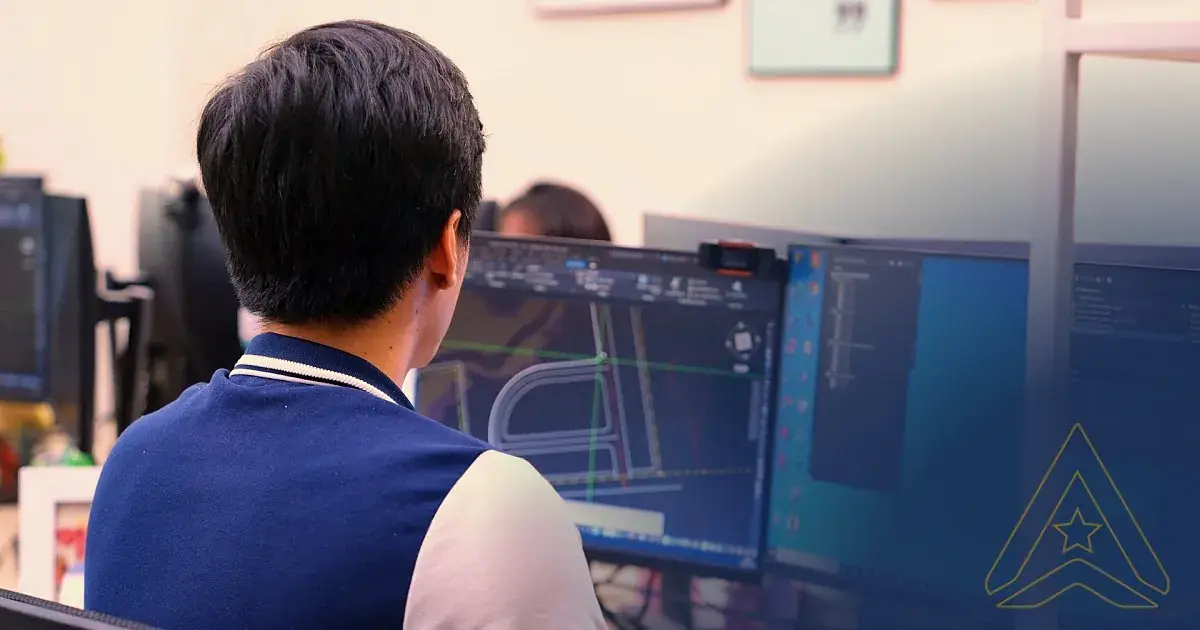
For outsourcing, this changes what a client should expect from a partner. Two years ago the question was “how many drafters do you have?”. The better question now is “what do you automate, how do you check it, and who is accountable for the result?”. ASCE’s president put the principle plainly in October 2026: even with AI, the work requires a knowledgeable, ethical human to study and validate solutions.
Our own practice follows that line. AXANH LAB, the unit that grew out of our long-standing R&D team, builds automation for the repeatable parts of Civil 3D plan production and applies AI across daily work; every result is checked by an engineer before it reaches a client, and professional responsibility never moves. The gain our clients notice is steadier turnaround on predictable work, which frees the engineers on both sides for the decisions that matter. How we govern that is on Responsible AI in Engineering.
04 · Model-based delivery
Trend 4: Civil 3D and model-based delivery become the baseline for outsourced work
Autodesk’s 2026 transportation research notes that BIM and GIS are now firmly in place with owners, and that a significant portion of leaders still report challenges with interoperability and rework caused by siloed systems and inconsistent standards. The direction is consistent: owners and agencies increasingly expect a coordinated model, not a set of unconnected drawings.
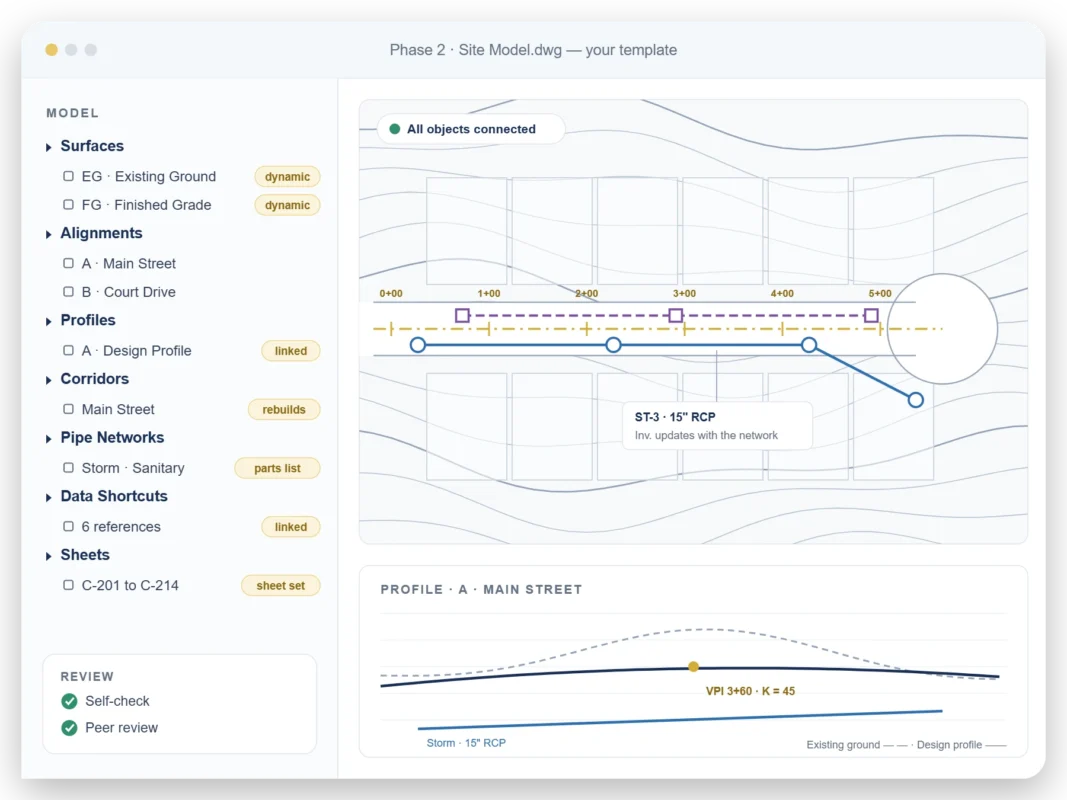
For outsourcing this raises the bar. A partner who delivers 2D linework is now a liability on a model-based project, because the client has to rebuild the model to coordinate it. The practical questions have become specific: can the partner work inside your Civil 3D template so surfaces, corridors and pipe networks rebuild on your side? Do they manage sheet sets so the plan set regenerates from the model rather than from manual edits? Do they understand ISO 19650 information management when a client requires it? At AXANH, 67 engineers hold Autodesk Civil 3D certificates of completion, the team runs an annual Civil 3D assessment, our teams typically produce plan sets through Civil 3D Sheet Set Manager, and our engineers completed Autodesk-led ISO 19650 training in September 2026. We describe the modeling discipline on the Civil 3D outsourcing page.
Source: Autodesk, 2026 State of Design & Make Spotlight on Transportation.
05 · Governance
Trend 5: Clients are asking sharper questions about responsible charge, data and licensing
Three years ago, outsourcing due diligence often stopped at a sample drawing and a rate. In 2026 the questions have matured, and three themes dominate. The first is responsible charge: under NSPE’s position and the NCEES model law, the licensed engineer must exercise direct control and personal supervision throughout the design, so outsourced work has to be structured with the engineer of record involved at the decision points. That is a process requirement the partner has to support.
Responsible charge
How AXANH answersWork is structured so the client’s engineer of record is involved at every decision point, as NSPE’s position requires, and the partner’s handoff notes record each decision.
Data governance
How AXANH answersNDA terms, role-based file access and clear rules for how AI tools handle client information, so project data stays tied to the purpose it was shared for.
Software licensing
How AXANH answersEvery seat touching client files is genuinely licensed, and license records are kept and reconciled so a client can ask to see them.
We answer those questions on Trust & Compliance, and our quality management system is certified to ISO 9001:2015. In Europe and Australia, ISO 19650 information management is increasingly part of the same conversation.
Source: NSPE Position Statement on Responsible Charge.
Build these three questions into your selection process now. They will be standard in every RFP by 2027.
06 · Leadership ownership
Trend 6: Outsourcing becomes a leadership decision about capacity, not a procurement decision about cost
The quieter trend is organizational. Outsourcing used to be arranged by a CAD manager under budget pressure. Increasingly it is a principal-level decision inside a capacity plan that also covers hiring, automation and which work the firm declines. ACEC’s Q2 2026 findings include a telling detail: among firms that have turned down work because of workforce shortages, 60% are turning down the less profitable work. Firms are getting more deliberate about where their scarce engineering hours go.
That maturity changes the conversation with a partner. The question is no longer “what is your rate?” but “which parts of our delivery should sit with you so our senior engineers stay on design judgment and client relationships?”. We wrote the framework for that decision in The AEC Capacity Decision, and the engagement shapes it leads to in Partnership Models.
The thread through all six
Outsourcing is becoming a capacity strategy owned by leadership, not a cost line owned by procurement.
The firms that will be comfortable in 2027 are the ones treating 2026 as the year to build the process.
07 · What to do
What these trends mean for a firm planning 2027
| Trend | What to do in your firm |
|---|---|
| Structural capacity gap | Put external capacity in the annual plan, with trigger conditions and an accountable owner |
| Hours to partnership | Write scopes that name deliverables, standards, review layers and decision owners |
| AI in production | Ask partners how AI is used and verified; require human review on every result |
| Model-based delivery | Select on Civil 3D template discipline and sheet set workflow, not 2D samples |
| Sharper governance | Make responsible charge, data access and licensing standard due-diligence questions |
| Leadership ownership | Decide at principal level which work stays internal and which moves to a partner |
None of this requires a large commitment to start. Most of our relationships began with one defined package, which is also the best way to test whether a partner behaves the way these trends demand. The steps are in Steps in Outsourcing Civil Engineering.
08 · FAQ
Questions about civil engineering outsourcing trends
Is AI reducing the need for outsourced civil engineering?
Not in what we see. AI is changing the mix of work, with more time on review and decisions and less on repetitive production, but the underlying shortage of engineers remains. Partners that combine automation with disciplined human review are becoming more useful, not less.
How should a firm test a new partner against these trends?
With one defined package: a phase of one project, with scope, standards, review layers and decision owners written down. The first package shows how the partner handles questions, review and handoff under a known load.
What should a firm look for first in a partner in 2026?
Evidence of continuity and review discipline: a stable team, recorded client standards, defined review layers, a certified quality system, and clear answers on AI use, data access and licensing.
Next step
Plan 2027 capacity with a partner who has seen the pattern
If your firm is deciding how much production capacity to hold internally next year, a conversation with our CEO is a useful hour. Bring your backlog and your hiring plan; we will tell you where external capacity fits and where it does not.
