








A seven-question framework for civil engineering and AEC firms evaluating outsourced design capacity, operating fit, and long-term partnership value.
Hourly rate is one of the easiest numbers to compare when evaluating engineering outsourcing. That is useful, but it can also make the simplest number in the proposal carry more weight than the operating reality behind it.
Two providers can offer similar engineering skills at very different rates and still create very different demands on the client’s organization. Onboarding, coordination, supervision, review, rework, lost context, technology controls, and escalation all consume time somewhere in the relationship.
A lower hourly rate may still be the better commercial choice. A higher rate may also be justified. The rate alone cannot tell you which is true.
A more useful question is: What will it take for outsourced engineering hours to become usable capacity inside our organization?
As an operating lens, usable capacity can be thought of as the engineering capacity purchased, less the avoidable effort required to coordinate it, correct preventable issues, and repeatedly rebuild context. It is not an accounting formula. It is a better way to expose costs that rarely appear on a rate card.
That provides a stronger starting point for evaluating a civil engineering outsourcing partner. The decision is no longer only about the price of labor. It becomes a question of how effectively external capacity can be integrated, reviewed, governed, and improved over time.
If your organization is still deciding between transactional outsourcing and a longer-term design-partner model, our earlier perspective on why a civil engineering design partner matters provides useful background. This article starts at the next decision: how to evaluate that partner.
Hourly rate is useful—but incomplete
Engineering outsourcing changes where work is performed. It does not eliminate the work required to define, coordinate, review, and integrate that capacity.
A lower rate can lose much of its advantage if a principal, project manager, or senior engineer must spend excessive time clarifying routine requirements, checking preventable issues, restoring lost context, or managing individual contributors in detail.
A higher rate does not automatically create better economics either. Paying more only makes sense when the operating model creates corresponding value in capability, reliability, lower management friction, or another outcome that matters to the client.
The useful comparison is therefore not simply rate versus rate. It is the relationship between the capacity purchased and the internal effort required to make that capacity useful.
That distinction matters because client-side time is not free. A project manager who spends ten additional hours managing fragmented external work has ten fewer hours available for client decisions, technical leadership, coordination, or other higher-value responsibilities.
The buyer’s task is not to eliminate management or review. Both remain necessary in a serious engineering environment. The task is to determine whether the relationship makes those activities clearer and more proportionate as the teams learn to work together.
For that decision, a different set of questions is more useful than the rate card alone.
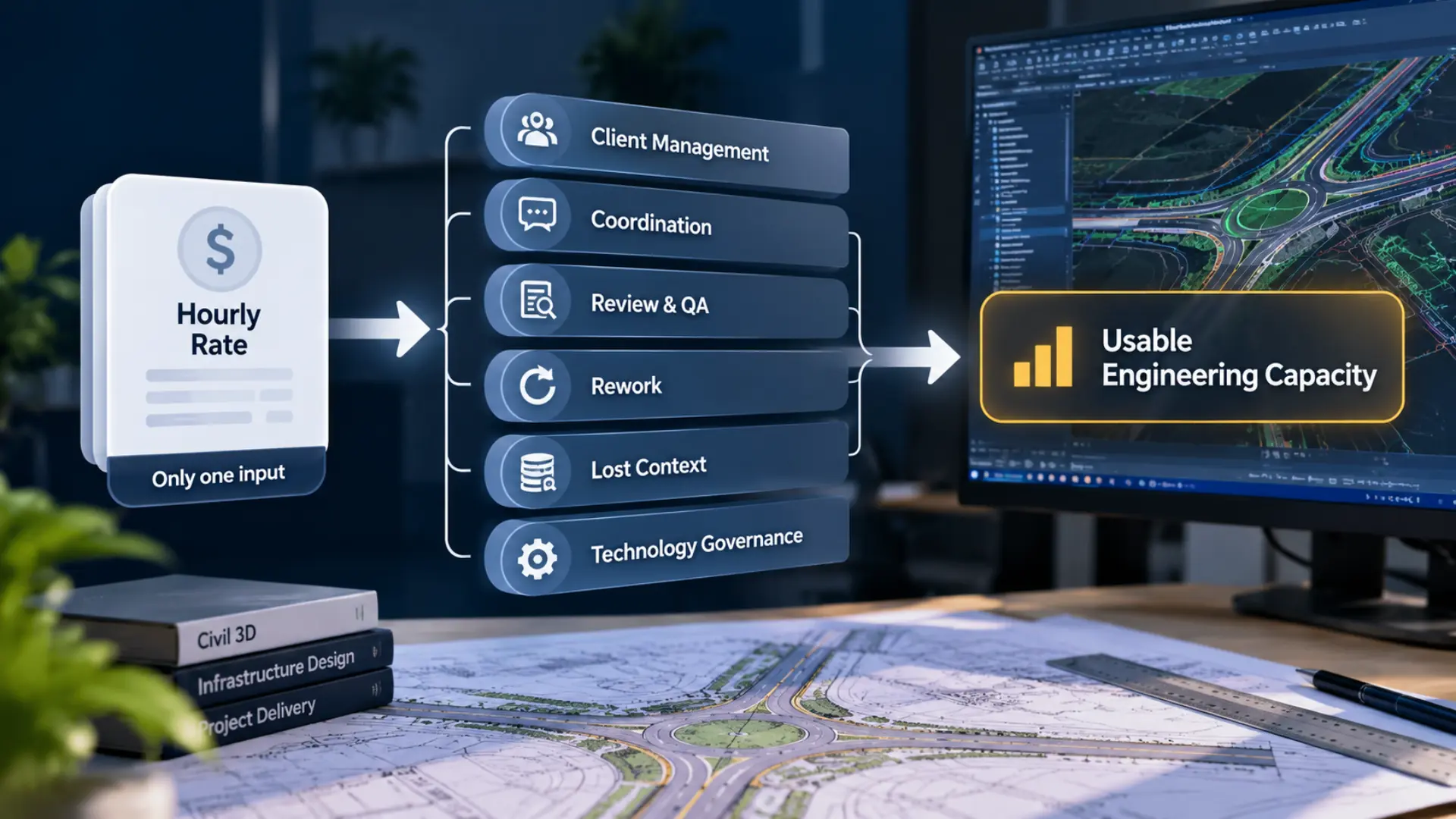
How to Evaluate a Civil Engineering Outsourcing Partner: Seven Questions to Ask
1. How much client-side management will the relationship require?
One of the least visible costs in engineering outsourcing is the client’s own management time.
Before an engagement begins, buyers naturally ask how many engineers are available, what software they use, what experience they have, what they cost, and how quickly they can start. Those questions matter. They do not explain who will manage the work once delivery begins.
A capable provider should be able to describe its operating model before the client has to discover it through day-to-day friction.
Ask who owns routine coordination, how open items are tracked, how questions are escalated, which decisions the external team can make within agreed authority, and where client approval is required.
Also ask what the provider expects from your organization. How much time should a project manager, technical lead, or principal reasonably expect to spend during onboarding? What should become easier after the team understands your standards and workflow?
A new, unfamiliar, or technically demanding scope may require substantial client involvement initially. That is not automatically a weakness. The more important test is whether responsibilities become clearer and the management burden becomes more appropriate as the relationship matures.
What to look for: clear ownership, decision boundaries, escalation paths, communication cadence, and a credible explanation of how much client management the model requires.
2. How is capability assessed after people are hired?
Resumes, years of experience, software proficiency, and project history are useful screening signals. They are not the same as evidence that capability is being maintained and developed inside the organization.
This distinction matters because a client is not only buying access to individual engineers. It is relying on the provider to maintain capable people as software, standards, project conditions, and client expectations change.
Experience should therefore be treated as an input, not as permanent proof of readiness.
Ask how capability gaps are identified, whether important skills are reassessed, what happens when further development is needed, and how learning connects back to real delivery requirements.
The objective is not to collect the largest number of certificates. A certificate can document a specific checkpoint; it does not automatically establish professional responsibility, project quality, or capability across every type of work.
The more useful question is: How does the organization know its people remain ready for the work they are being asked to perform?
What to look for: recurring assessment or review, structured development, evidence of application, and a clear distinction between training records and proven delivery responsibility.
3. What happens to project context when people change?
Some of the most valuable knowledge in a long-running engineering relationship never appears completely in the drawing set.
Over time, a team learns how a client structures files, interprets standards, handles review comments, records decisions, communicates open questions, prioritizes issues, and distinguishes matters that require escalation from those that can be resolved within an agreed workflow.
That accumulated knowledge is part of the value of the relationship.
If it exists only in one person’s memory, a personnel change can force the client to spend time rebuilding context that has already been paid for once.
For a longer-term relationship, continuity should therefore be examined at the organizational level, not only at the individual level.
Ask how important decisions are captured, how handoffs are performed, how client-specific standards and preferences are transferred appropriately, and how the provider separates reusable organizational learning from confidential, client-specific, or jurisdiction-specific information.
Also ask a simple operational question: if a key engineer changes tomorrow, what would the replacement already know before the client has to explain the project again?
The goal is not to pretend that personnel changes never happen. It is to reduce the amount of useful context that disappears when they do.
What to look for: disciplined handoffs, decision capture, knowledge transfer, appropriate documentation, and continuity that does not depend entirely on one individual’s memory.
4. Where does review responsibility sit?
Outsourcing engineering production does not outsource every layer of client, technical, or professional responsibility.
That boundary should be explicit before work begins.
Statements such as “multi-layer QA/QC” can sound reassuring while revealing very little. A buyer still needs to know what is checked, who performs the review, when it occurs, what happens when an issue remains unresolved, and what responsibility stays with the client or responsible professional.
The provider should be able to describe what the person producing the work is expected to check before handoff, when an additional independent review is appropriate, and what state a deliverable is expected to reach before entering the client’s own review process.
Review depth should also match the work. A routine production task and a technically sensitive design package should not automatically receive the same control sequence.
Client review remains important where applicable. The objective is not to remove it. The objective is to avoid using the client’s review process as the default first line of defense against preventable issues.
A useful due-diligence question is therefore not “Do you have QA/QC?” but “Show me how review responsibility changes with scope, risk, and deliverable stage.”
What to look for: review controls fitted to scope and risk, explicit ownership, transparent limitations, documented escalation, and a clear distinction between provider review and professional responsibility retained elsewhere.
5. How are software, access, and AI governed?
Technology should be evaluated as part of the operating model, not as a collection of software logos.
When a provider discusses Civil 3D, Revit, cloud platforms, automation, or AI, separate two questions: What tools can your team use? and How are those tools governed when client work is involved?
Buyers should understand whether commercial software is appropriately licensed and authorized, who can access project information, how access is restricted to its intended purpose, and what happens when people join, leave, or change responsibilities.
The same discipline applies to AI.
The important question is not simply whether a provider “uses AI.” Ask which tasks AI may assist, what types of information may or may not be entered, what confidentiality or IP boundaries apply, how output is verified, and who remains accountable when engineering judgment is required.
Broader frameworks such as the NIST AI Risk Management Framework can provide useful reference points for organizations developing governance, accountability, and risk-management practices around AI-enabled systems.
Technology can increase capacity and reduce repetitive effort. Poor governance can introduce a different kind of operating burden.
What to look for: appropriately licensed tools, controlled access, clear data boundaries, human verification, defined accountability, and specific answers about permitted AI use rather than broad innovation claims.
6. How does the team learn your market and operating context?
A remote or offshore engineering team can be technically capable and still be far from the environment in which its client makes decisions.
Drawings and models sit inside a larger system: client standards, authority structures, reviewer expectations, permitting environments, communication habits, constructability considerations, and the reasoning behind previous decisions.
No team learns all of that from a kickoff call.
Ask how the provider captures standards and working preferences during onboarding, how review feedback is carried into later assignments, whether recurring comments are converted into better understanding, and how managers learn the client’s decision structure.
Also ask what the provider does when it does not know.
That question matters because strong market-context learning includes knowing where the boundary sits. Exposure to one client, project, state, country, or jurisdiction does not make an external team the local professional authority everywhere.
The objective is narrower and more practical: reduce contextual distance over time while keeping jurisdiction-specific interpretation and professional responsibility with the appropriate parties.
For clients, the desired progression is not simply “the team knows our software.” It is “the team increasingly understands why we work this way, which decisions matter, and when a question should be escalated.”
What to look for: deliberate onboarding, feedback loops, context transfer, curiosity about the reasoning behind standards, and an honest recognition of jurisdictional and professional limits.
7. Can the relationship start at the right size and deepen only when it makes sense?
A good engineering outsourcing relationship does not have to begin with the largest team or the longest commitment.
Technical fit, communication quality, review behavior, standards alignment, continuity, and management burden become easier to evaluate after both organizations have worked together on something real.
A defined starting scope can therefore be useful, provided it is substantial enough to test the characteristics that matter.
Before that initial engagement begins, both sides should agree on what they are trying to learn. Speed alone is a weak success criterion. Evaluation should also consider the quality of questions, readiness for review, response to feedback, transparency about uncertainty, client-side effort, and whether relevant context carries into the next assignment.
The client should also know what would justify a deeper relationship.
More people are not automatically better. A dedicated structure is not automatically better. Greater integration creates value only when workload, continuity needs, governance readiness, economics, and mutual operating fit support it.
The strongest provider is therefore not necessarily the one prepared to scale fastest. It is the one whose engagement model can expand at the same pace as proven operating fit.
What to look for: a defined starting scope, explicit evaluation criteria, clear conditions for scaling, and an engagement model that does not make deeper commitment the assumed destination.
Engineering Outsourcing Partner Evaluation Scorecard
These seven questions can be reduced to a practical engineering outsourcing partner evaluation framework for proposal reviews, interviews, or due diligence.
One simple approach is to ask the evaluation team to rate each area from 1 to 5 only after evidence has been reviewed. The number itself is less important than documenting why the score was given and what remains unverified.
| Evaluation area | Stronger evidence | Weak signal |
|---|---|---|
| Client-side management | Named ownership, escalation paths, decision boundaries, reporting rhythm, and a clear description of required client involvement | “Seamless extension of your team” without explaining who manages what |
| Capability | Recurring assessment or review, structured development, evidence of application, and clear capability boundaries | Resumes, years of experience, certificates, or software lists presented as sufficient proof on their own |
| Context continuity | Decision capture, disciplined handoffs, standards transfer, and an approach to retaining useful project context | Important project knowledge depends mainly on individual memory |
| Review | Controls matched to scope, risk, responsibility, and deliverable stage, with unresolved issues escalated explicitly | Generic claims of “multi-layer QA/QC” without defining review responsibility |
| Technology | Appropriately licensed tools, controlled access, data boundaries, human verification, and accountable AI use | Software logos, broad security statements, or AI claims without operating controls |
| Market context | Structured onboarding, feedback loops, deliberate context learning, and clear jurisdictional boundaries | Generic claims of international experience without explaining how client context is learned |
| Partnership fit | A defined starting scope with evidence-based criteria for maintaining, changing, or deepening the relationship | Large or long-term commitment encouraged before operating fit has been tested |
No single row determines which provider is right.
A technically strong team can still require excessive supervision. A stable team can still have weak review discipline. Good technology can still create risk if access and accountability are unclear. A higher-priced provider can still create unnecessary complexity. And the lowest rate can still be the best commercial choice when the surrounding operating model is strong.
The scorecard is useful because it forces the discussion beyond the easiest number on the proposal. It also makes disagreements inside the buying team easier to examine: two evaluators may assign different scores, but they should be able to explain the evidence behind them.
How AXANH applies the same questions to partnership design
AXANH uses these operating questions when thinking about how external engineering capacity should fit a client organization. The framework is useful only if the provider is willing to apply the same scrutiny to itself.
- Capability is revisited rather than treated as permanent. Civil 3D is one example of AXANH’s recurring capability-development approach. Assessment and completion evidence are treated as specific checkpoints, not as a substitute for professional licensure or a guarantee of project outcomes.
- Review is fitted to the work and sits inside a broader quality system. Self-check, peer review, and manager review are available review perspectives, with the appropriate configuration depending on scope, risk, work type, and agreed responsibility. AXANH Company Limited’s quality management system was certified to ISO 9001:2015 in September 2026 within the scope stated on its certificate; that certification supports quality governance and process discipline, not a claim that every deliverable is automatically error-free or “ISO-certified.”
- Client context is developed deliberately. AXANH’s engineering heritage includes documented client-context learning in the United States, subsequent market and project learning, and direct knowledge exchange with an experienced U.S. professional engineer in Vietnam. The purpose is to reduce contextual distance, not to replace local professional responsibility or claim mastery of every jurisdiction.
- Technology and partnership depth are governed rather than assumed. AXANH’s operating principles include appropriately licensed and authorized software, purpose-based access, confidentiality boundaries, and human accountability for technical judgment. Engagement can begin with defined project support and deepen only when workload, trust, governance, and business value justify the next stage.
These mechanisms do not mean every client should use the same engagement model. They are intended to make the operating model easier to examine before the relationship becomes larger, more integrated, or more important.
For a broader view of how technical capability, quality review, technology, and partner delivery are organized, explore AXANH Capabilities.
The better comparison is usable capacity
Hourly rate still belongs in the decision. It simply belongs beside a wider operating picture.
When two proposals have different rates, calculate what the rate difference means. Then examine what your own organization must contribute to turn each proposal into dependable capacity: management time, review effort, coordination, context transfer, technology governance, and escalation.
Three questions usually make the comparison clearer. How much engineering capacity are we buying? How much internal effort will be required to use it well? And should that effort become more proportionate as the external team learns our standards and operating context?
The right engineering outsourcing partner is therefore not necessarily the provider with the lowest rate, the largest team, or the longest software list. It is the provider whose capacity can be integrated with a level of management, review, continuity, and governance that makes sense for your organization.
The longer-term test comes after the first assignments. Does the external team retain useful context? Do questions become better? Are review boundaries clearer? Is client management focused increasingly on meaningful decisions rather than repeated explanation? Does the engagement model adapt as the relationship becomes better understood?
Those questions reveal more about the economics of engineering outsourcing than the hourly rate alone.
The objective is not to purchase the largest number of engineering hours at the lowest possible price. It is to build engineering capacity your organization can use, govern, and trust at the level the work actually requires.
Evaluate operating fit before you scale
If you are comparing external engineering capacity, examine the ownership, resource certainty, delivery responsibility, and governance depth that your organization actually needs.
