









A common data environment for infrastructure projects helps engineering teams control which information is being developed, reviewed, approved, and released for use. Its real value is the confidence that people are making decisions from the right information at the right time.
Imagine a construction team working from one drawing revision while the design team has already issued another. Both teams may believe they are using the latest information. The problem is not necessarily the quality of either drawing. It is that the information exchange failed to keep everyone aligned.
In complex infrastructure delivery, that disconnect can affect coordination, trigger unnecessary rework, and leave teams questioning which decisions were made against which information.
This is the challenge a common data environment (CDE) is designed to address. Guided by information-management principles such as ISO 19650, a CDE helps teams establish a dependable process for creating, sharing, reviewing, authorizing, and retaining project information.
The following guide explores what that means in practice, from information states and approval workflows to the role of platforms such as Autodesk Forma Data Management.
The hidden risk in infrastructure delivery: information that cannot be trusted
Infrastructure design brings together information from many sources. Survey data informs existing-ground models. Utility records influence design decisions. Drainage calculations affect alignments, profiles, and drawings. Each discipline depends on information that another person or team has produced.
As a project develops, these inputs change. A survey update may require changes to a model. Revised utility information may affect an alignment. Review comments may require a new drawing issue.
The challenge is keeping those changes connected to the people who need to act on them.
When project information is scattered across email threads, personal folders, cloud drives, and separate collaboration tools, teams can struggle to answer five essential questions:
- Which version is authoritative? Is this the information intended for the current activity?
- What can it be used for? Is it suitable for coordination, review, or an authorized downstream purpose?
- Who is responsible? Who produced, checked, and approved the information?
- What has changed? Can the receiving team identify the changes relevant to its work?
- Can the decision be traced? Is there a reliable record of the information available when a decision was made?
These are engineering-delivery questions, even when the immediate symptoms look like document-control problems.
What is a common data environment under ISO 19650?
A common data environment (CDE) is an agreed source of information for a project or asset, supported by processes for managing the collection, management, and dissemination of information containers through a controlled workflow.
ISO 19650-1 describes concepts and principles for managing information across the life cycle of built assets. ISO 19650-2 addresses information-management processes during the delivery phase.
A CDE helps put those principles into practice by making information status, responsibilities, exchanges, and records visible to the relevant project participants.
The distinction between a CDE and a shared cloud drive becomes clear when we consider what happens after a document has been uploaded.
| Shared cloud storage | Controlled CDE workflow |
|---|---|
| Stores files in a shared location | Manages information according to agreed project states and rules |
| May retain multiple file versions | Connects versions and revisions to status and intended use |
| Allows users to share documents | Defines responsibilities for sharing, review, authorization, and release |
| Can preserve file activity | Supports traceability of submissions, decisions, and information exchanges |
| Helps people locate information | Helps people determine which information is suitable for a particular decision |
A shared drive can form part of an organization’s information-management solution. What makes the difference is the agreed process governing how information is identified, checked, shared, and authorized.
Four information states that bring clarity to project coordination
One of the most useful ideas associated with the ISO 19650 CDE workflow is that information has a defined state. That state communicates where the information sits in the process and how others should treat it.
| Information state | Purpose | Practical meaning |
|---|---|---|
| Work in Progress (WIP) | Information under development | The originating team develops and checks information before releasing it for wider coordination. |
| Shared | Information available for defined collaborative purposes | Other authorized teams can coordinate or review it according to its stated suitability. |
| Published | Information authorized for its designated use | The appropriate authorization has been completed for the information’s intended purpose. |
| Archive | Retained information history | The project preserves relevant records of issues, changes, and authorization history. |
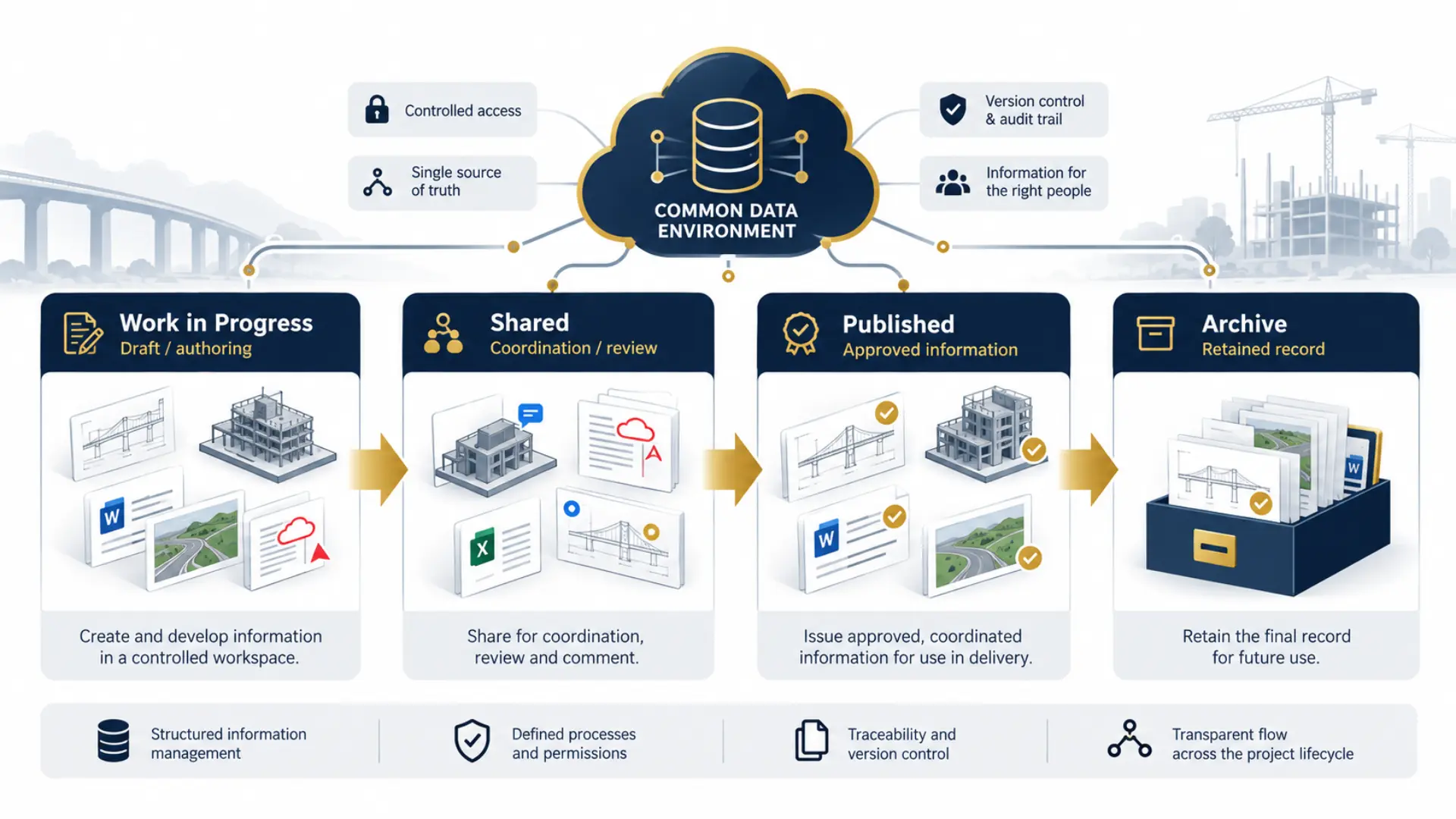
Consider a drainage design model. While engineers are developing and checking the model, it remains within the appropriate work-in-progress process. Once it meets the agreed sharing requirements, other disciplines can reference it for coordination. Following the required review and authorization, an approved information package can be released for its designated use.
The essential point is that information does not become suitable for every purpose simply because someone can access it. Its status, suitability, and authorization must be understood together.
Five controls that turn information sharing into dependable delivery
Information states provide the structure. Reliable coordination also depends on the controls that govern how information moves between those states.
1. Version and revision control
Engineers need a clear distinction between the latest uploaded version, the relevant revision, and the information authorized for a particular use.
A current working model may contain changes that have not been approved for downstream use. Conversely, an earlier authorized issue may remain the applicable reference for a specific construction activity until a replacement is formally released.
Good version control makes these differences visible and helps prevent teams from treating every new upload as a new instruction.
2. Clear ownership and decision rights
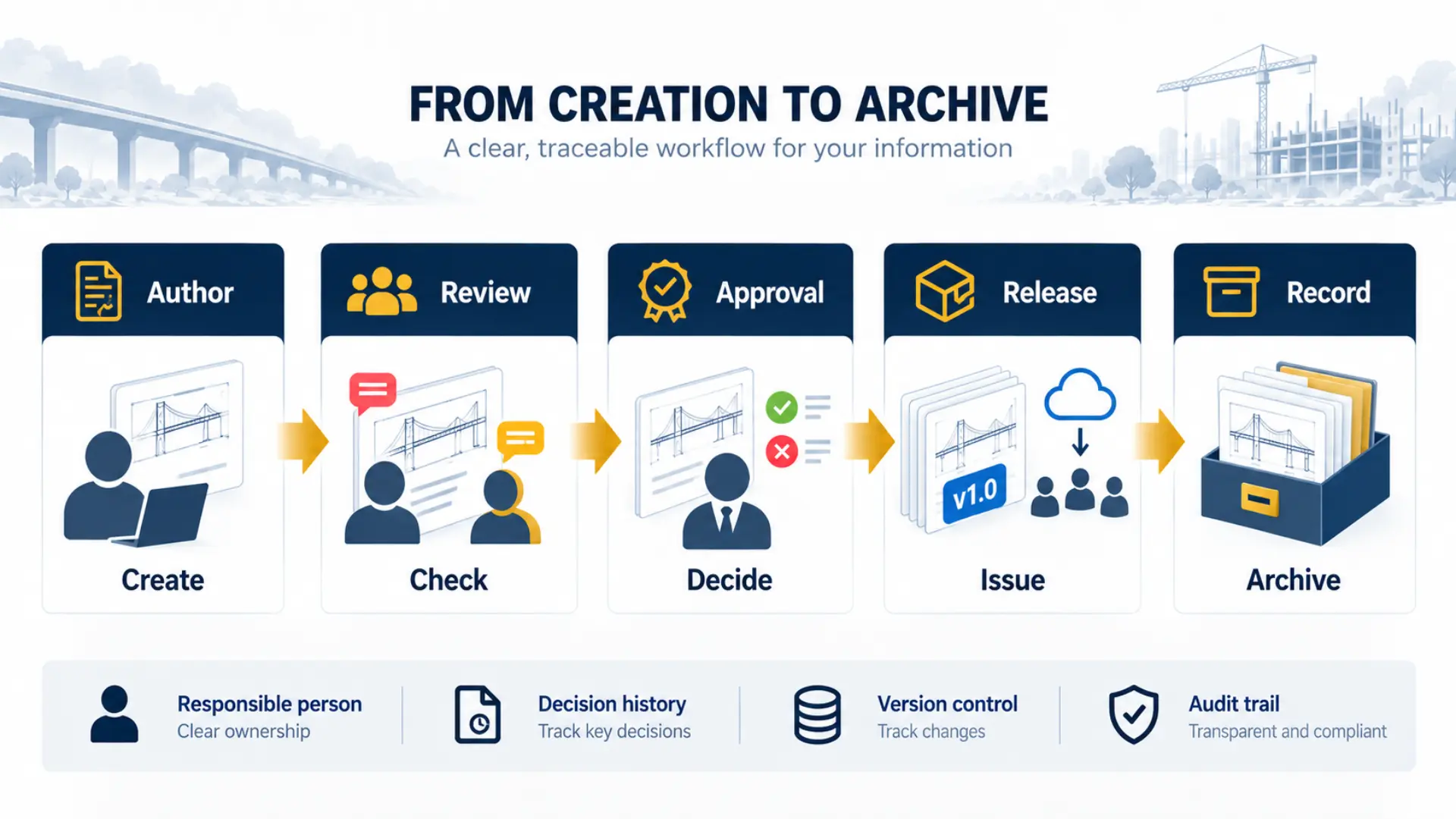
Creating information, checking technical content, approving a submission, and authorizing release are different responsibilities.
As multiple organizations contribute to a project, these responsibilities should remain clear. A CDE can support this through role-based access, permissions, and defined review assignments.
The platform can record and enforce aspects of the workflow, while the project team remains responsible for defining who has the authority to make each decision.
3. Review and approval workflows
Information should advance because an agreed decision has been made, rather than because a file was copied into another folder.
Structured review workflows help establish what must be checked, who participates, what comments require resolution, and which authorization permits information to move forward.
For a multidisciplinary design package, this creates a clearer connection between technical review and formal information release.
4. Consistent naming and metadata
A well-organized information environment allows users to identify information without opening every file.
Project-defined naming conventions, revision identifiers, status or suitability information, and relevant metadata make information easier to classify, retrieve, and manage.
Consistency matters especially when large teams exchange models, drawings, calculations, and reference documents across organizations.
5. Traceability of decisions and changes
When a coordination question emerges, the team should be able to establish which information was submitted, which comments were raised, what changed, and what was ultimately authorized.
This traceability supports design review, change management, handovers, and later investigation of project decisions.
Finding a file tells a team where information is stored. Tracing its history helps the team understand why that information can be relied upon.
Why infrastructure projects need stronger information coordination
Infrastructure projects bring particular complexity because their design information is closely connected to physical conditions, geographic references, and the work of multiple disciplines.
For a civil infrastructure team, a coordinated information environment may need to accommodate:
- Survey information and existing-ground surfaces
- Existing utility records and proposed utility networks
- Road, site grading, and corridor models
- Stormwater and drainage design information
- Multidisciplinary drawings and design references
- Design calculations, technical comments, and review records
- Approved submissions and project handover information
These information sources are interdependent. An updated utility location may affect a drainage crossing. A revised survey surface may change grading assumptions. A corridor adjustment may require several drawings and dependent models to be reviewed.
Managing those changes requires more than distributing updated files. Teams need to understand which information has changed, whether its downstream implications have been assessed, and whether the relevant deliverables remain aligned.
This is where a CDE contributes to delivery discipline. It creates an environment in which structured information exchange can support technical coordination rather than leaving every handoff dependent on informal communication.
How Autodesk Forma Data Management supports a CDE workflow
Autodesk Forma Data Management, formerly Autodesk Docs, is a cloud-based information-management environment designed for architecture, engineering, construction, and operations workflows.
It provides capabilities that can support a CDE implementation, including file and version management, document organization, naming standards, access controls, markups, and review-related processes.
These capabilities help translate an agreed information-management process into activities that project participants can follow and record.
For example, a design submission can move through a defined review process in which responsibilities, comments, decisions, and information history are captured more systematically.
However, effective implementation begins before software configuration.
A project needs to establish its information requirements, naming conventions, review responsibilities, authorization rules, and intended uses. These decisions determine how the available technology should be configured.
A useful implementation question is therefore: Can the platform support the actual decisions and information exchanges the project needs to control?
A practical way to start: control one information exchange
Introducing better information management does not have to begin with a complete redesign of every project workflow.
For an engineering organization exploring a CDE, a focused pilot can reveal whether the required controls are clear, practical, and repeatable.
Start with one meaningful exchange, such as a multidisciplinary drawing package, coordinated model submission, or design review cycle.
Then work through the following steps:
- Define the information requirement. Identify what must be delivered, the intended recipient, and the purpose for which it will be used.
- Assign responsibilities. Confirm who prepares, checks, reviews, authorizes, and receives the information.
- Establish information rules. Agree on naming, metadata, revision identification, information status, and suitability.
- Map the approval process. Determine what must happen before information can move from development to coordination or authorized release.
- Retain the decision record. Preserve the information needed to reconstruct submissions, reviews, changes, and approvals.
- Evaluate the exchange. Review whether the process reduced ambiguity, made responsibilities clearer, and allowed the information history to be reconstructed without relying on personal correspondence.
The pilot should be assessed using actual project records, rather than assumptions about what a platform is expected to achieve.
Useful questions include whether recipients could identify the correct revision, whether review comments were traceable, and whether the team could establish who authorized the released information.
These observations help reveal where the workflow is effective and where additional clarity, training, or governance is needed.
Common questions about CDEs and ISO 19650
Is a common data environment the same as cloud storage?
No. Cloud storage provides a location for project files. A common data environment adds agreed information-management processes, including information states, responsibilities, version and revision control, review, authorization, and traceability. Cloud technology can support those processes, but storage alone does not establish them.
Does ISO 19650 require one specific software platform?
No. The ISO 19650 series establishes information-management principles and requirements rather than mandating a particular software vendor. Organizations select and configure technology based on their project requirements, responsibilities, and agreed information workflows.
Can a CDE support civil infrastructure design projects?
Yes. A CDE can support the controlled exchange of survey data, drawings, engineering models, utility information, design submissions, and review records. Its usefulness depends on how clearly information requirements, status, authorization, and responsibilities are established for the project.
Building confidence through better information management
Engineering decisions are only as dependable as the information available to support them.
A well-managed CDE helps project teams make that information easier to understand, coordinate, review, and trust. It brings greater clarity to what has been developed, what has been shared, what has been authorized, and what must remain traceable throughout delivery.
For engineering leaders, the opportunity is to strengthen the relationship between technical production and information governance. Clear responsibilities and controlled information exchanges give teams a stronger foundation for consistent collaboration as projects become more connected.
At AXANH, continued professional learning around information management forms part of a broader commitment to disciplined engineering practice. The team’s recent learning session with Autodesk explored ISO 19650 concepts and their relevance to digital project delivery.
That journey begins with a practical question every project team can ask: When information reaches the next person, can they confidently determine what it is, what it is ready for, and why it can be trusted?
Explore AXANH’s ISO 19650 Learning Journey
Discover how AXANH is strengthening its understanding of information management through professional learning with Autodesk, and why structured information exchange matters for modern engineering delivery.
